
Claude Opus 5 vs Fable 5: Which One Should I Use?
Quick Answer: If you’re doing coding, knowledge work, or agentic tasks, use Claude Opus 5. It beats Fable 5 on 9 of 14 official benchmarks at exactly half the price, has no 30-day data retention requirement, and gives you full access on both Pro and Max subscriptions instead of limited credits. Stick with Fable 5 only if you need long-horizon autonomous agents, cybersecurity research, or your use case specifically matches the 4 benchmarks where Fable still leads.
So Anthropic just did something unusual. They released a new model, Claude Opus 5, that’s cheaper than their existing flagship and beats it on most benchmarks. That’s not how new model launches normally work. Usually you pay more for better. Here you’re paying less for roughly equivalent, and in a lot of cases actually better.
Claude Opus 5 launched July 24, 2026, at $5/$25 per million tokens, the exact same price as Opus 4.8. Claude Fable 5, which launched June 9, 2026, costs $10/$50 per million tokens. So the Claude Opus 5 vs Fable 5 question becomes surprisingly simple at first glance: is the cheaper model actually worse? The answer, based on Anthropic’s own benchmarks and independent third-party testing, is that Opus 5 wins on most of the tests that matter for most developers.
But there are four specific areas where Fable 5 still leads. And there are two less obvious issues with Opus 5 that most comparison articles don’t cover, one about backward compatibility and one about hallucination rate, that are worth understanding before you make a decision.
Here’s the full, honest breakdown of when to use Claude Opus 5 vs Fable 5.
The Benchmark Breakdown: Where Each Model Wins
Let’s start with the data, because the headline numbers are genuinely surprising.
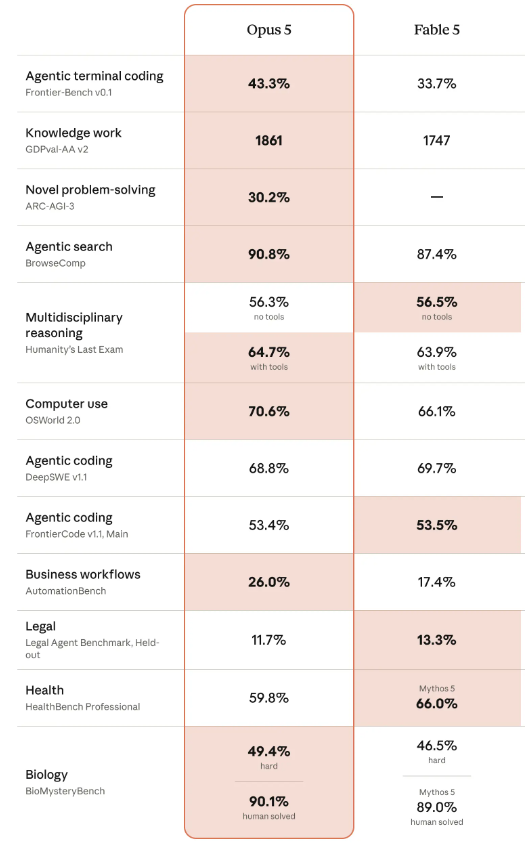
That table is from Anthropic’s official July 24 launch materials. The pink shading shows the winner on each row. Counting through it, Opus 5 wins on 9 of the 14 benchmark comparisons shown, often by meaningful margins:
Agentic terminal coding (Frontier-Bench v0.1): Opus 5 at 43.3% vs Fable 5’s 33.7%. That’s nearly a 10-point gap on the benchmark that most directly measures real software engineering work.
Knowledge work (GDPval-AA v2): Opus 5 scores 1861 vs Fable 5’s 1747.
Novel problem-solving (ARC-AGI-3): Opus 5 hits 30.2%. Fable 5 shows a dash, meaning it wasn’t included or didn’t produce a valid score.
Computer use (OSWorld 2.0): Opus 5 at 70.6% vs Fable 5’s 66.1%.
Business workflows (AutomationBench): Opus 5 at 26.0% vs Fable 5’s 17.4%. That’s a 49% relative improvement on business automation specifically.
Where Fable 5 still wins:
Legal (Legal Agent Benchmark): 13.3% vs Opus 5’s 11.7%.
Health (HealthBench Professional): 66.0% for Fable (via Mythos 5 capabilities) vs Opus 5’s 59.8%.
Agentic coding (DeepSWE v1.1): Fable 5 at 69.7% vs Opus 5’s 68.8%, a 0.9-point difference.
Agentic coding (FrontierCode v1.1): Fable 5 at 53.5% vs Opus 5’s 53.4%, a 0.1-point difference.
So on the agentic coding benchmarks where Fable 5 “wins,” the margins are less than 1 point. On the benchmarks where Opus 5 wins, the margins are frequently 5-10 points. That asymmetry matters when you’re deciding which model to default to.
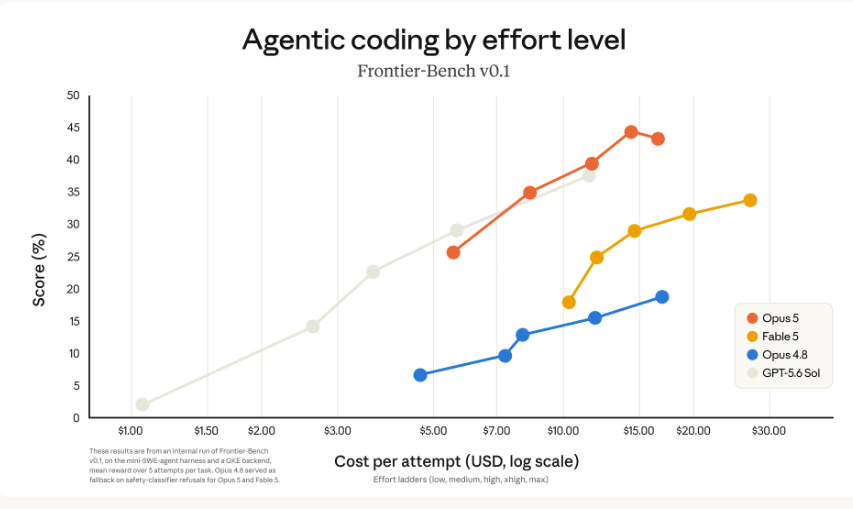
This chart from Anthropic’s launch materials is the most useful visual in the whole comparison. It plots score against cost per attempt, and the Opus 5 curve (red) sits consistently above the Fable 5 curve (yellow) at every single cost point. At the same cost, Opus 5 scores higher. That’s what “better value” actually means in practice, not just cheaper, but higher performance per dollar spent.
The Intelligence Index: An Independent View
Benchmark tables from model launches are useful but they’re vendor-reported. Let’s look at what an independent source shows.
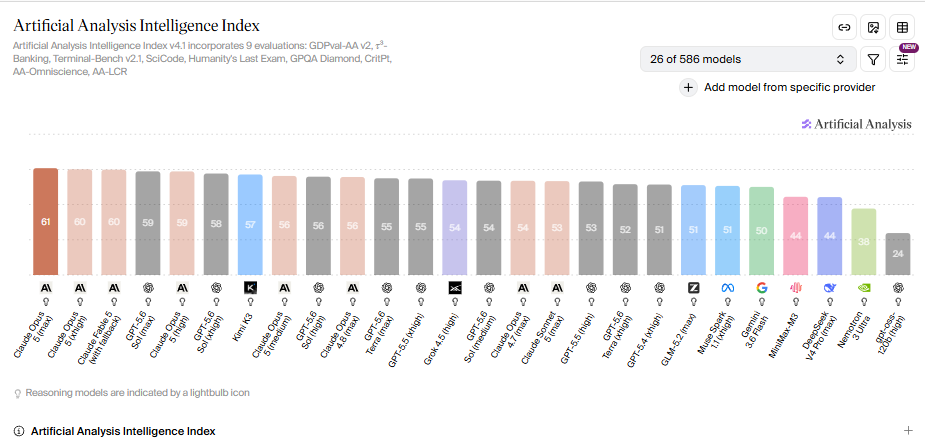
The Artificial Analysis Intelligence Index incorporates nine evaluations: GDPval-AA v2, r2-Banking, Terminal-Bench v2.1, SciCode, Humanity’s Last Exam, GPQA Diamond, CritPt, AA-Omniscience, and AA-LCR. It’s not affiliated with Anthropic. Claude Opus 5 scores 61. Claude Fable 5 scores 60. Opus 5 also appears with the “with fallback” label at 60, meaning even the version with fallback routing enabled matches Fable 5.
This is genuinely rare. A model that costs half as much outranking the more expensive flagship on an independent intelligence index the same day it launched. The practical read: if you’re picking between these two for everyday coding and knowledge work, the independent data backs Opus 5 as the starting point.
The Subscription Access Difference Nobody Talks About
Here’s the angle that changes the math completely for anyone on a Claude subscription rather than pure API billing.
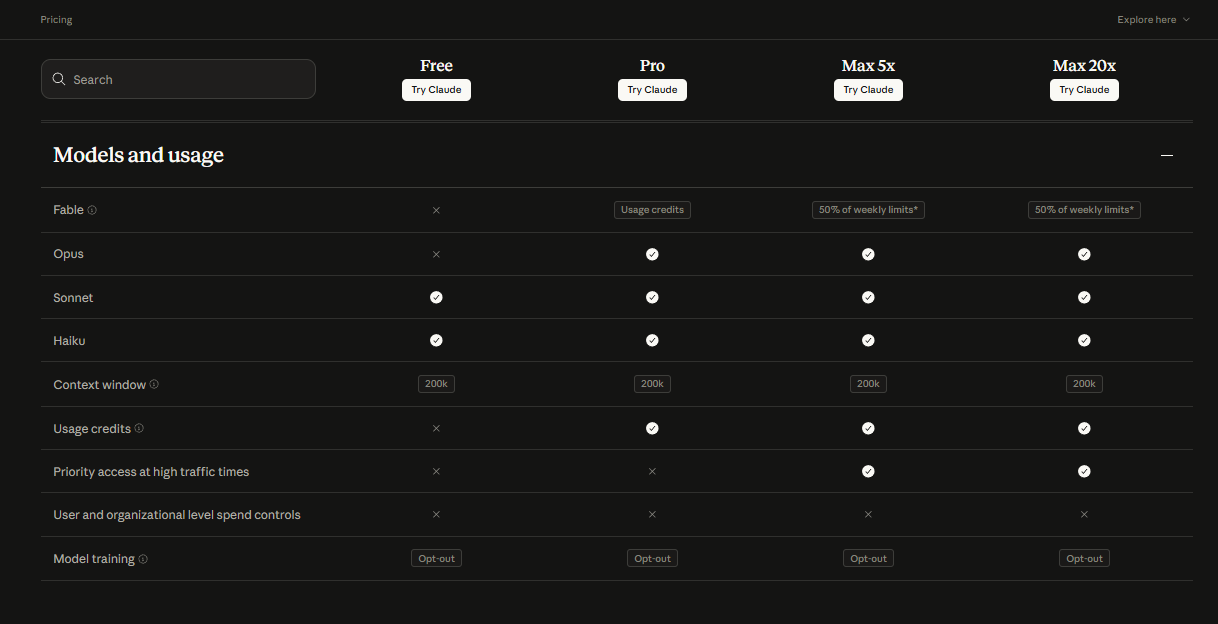
Look at that plan comparison table. On Claude Pro ($17-20/month), Fable 5 shows “Usage credits,” which means you’re drawing from a separate credit pool that limits how much you can use it. Opus shows a full checkmark, meaning it’s included in your normal plan usage without separate credit deductions.
On Max 5x and Max 20x, Fable 5 shows “50% of weekly limits” while Opus again shows a full checkmark.
A Hacker News commenter during the Opus 5 launch thread laid out the math clearly: “Half the price of Fable 5 and usable with 100% of your subscription means roughly 4x the usage.” That’s not just a cost saving. It’s 4x the actual work you can get done within your subscription before hitting limits, on a model that outperforms Fable 5 on most benchmarks.
The Real Cost Comparison (With Actual Task Numbers)
API token pricing matters, but real-world task cost matters more.
| Feature | Claude Opus 5 | Claude Fable 5 |
|---|---|---|
| API Input Price | $5 per million tokens | $10 per million tokens |
| API Output Price | $25 per million tokens | $50 per million tokens |
| Real task cost (coding) | ~$6 per complex task | ~$75 per complex task |
| Subscription access | Full checkmark on Pro and Max | Usage credits on Pro, 50% of weekly limits on Max |
| Data retention | Standard (no extended retention) | 30-day data retention requirement |
| Context window | 1M tokens | 1M tokens |
| Max output | 128k tokens standard, 300k via Message Batches API | 128k tokens |
| Thinking default | On by default (5-level effort toggle) | Always on (no toggle) |
| Artificial Analysis rank | 61 (ranked #1 at launch) | 60 (ranked #2 behind Opus 5) |
| Intelligence Index | #1 overall | #2 overall (behind Opus 5) |
The data retention point is one that competitors almost always skip and it matters for teams handling any sensitive data. Fable 5 and Mythos 5 carry a 30-day data retention requirement as part of their current terms. Opus 5 does not. If your organization handles confidential client data, legal documents, healthcare information, or anything where you’d rather not have extended retention, Opus 5 is structurally cleaner.
Alex Finn’s real-world testing (Geeky Gadgets, July 27, 2026) put real task cost into perspective: a complex coding task on Opus 5 came out to roughly $6. The same task on Fable 5 cost roughly $75. Even at Opus 5’s maximum effort setting, you’re looking at costs an order of magnitude lower than Fable 5 on equivalent work.
For context on how to control Opus 5’s costs further using the effort toggle, our Claude Opus 5 effort toggle guide covers the routing strategy that can cut costs another 40%.
What Claude Opus 5 vs Fable 5 Looks Like When You Actually Use It
Here’s where the conversation gets honest, because benchmarks don’t tell the whole story.
Dan Shipper, the founder of Every (a major AI-first publication), spent a week testing Opus 5 across coding, writing, knowledge work, and their internal agent. His day-one reaction on X was blunt:
💬 Expert quote, verified: Dan Shipper (@danshipper) on X, July 24, 2026: “It’s a poor man’s Fable. It has many of Fable’s personality quirks without Fable’s genius… It argued with instructions, stopped before the work was finished, and generally didn’t play well with our existing skills and plugins. Our first reaction was: What have they done to my boy?”
But the story didn’t end there. His team then deleted their existing skills and rebuilt from scratch without the workflows they’d built for older models. After that reset: “Opus 5 got dramatically better, and even showed flashes of brilliance.”
BREAKING: Claude Opus 5 is OUT NOW!
And…it’s a hard model to love.
We’ve spent the last week @every testing it across coding, writing, knowledge work, and our internal agent.
It argued with instructions, stopped before the work was finished, and generally didn’t play well… https://t.co/qpAq8mv5O1 pic.twitter.com/QWoL64tizS
— Dan Shipper 📧 (@danshipper) July 24, 2026
That pattern, frustration then improvement after workflow reset, shows up across developer reports in the first days after launch. The backward compatibility issue is real: if you have prompts, skills, or agent workflows built and optimized for Claude Opus 4.8, don’t assume they transfer cleanly to Opus 5. They often don’t. Opus 5 is a genuinely different model with different defaults, and it seems to perform best when given fresh instructions rather than inherited frameworks from older model versions.
There are two other things worth knowing that most comparison coverage is skipping:
Hallucination rate went up, even as accuracy went up. Finance AI newsletter Finstory AI flagged this in their Opus 5 analysis: on factuality testing, Opus 5 improved accuracy over Opus 4.8 but its hallucination rate actually climbed to around 50% because it now responds more frequently when uncertain instead of declining to answer. Fable 5 still trails on raw accuracy but is better calibrated about what it doesn’t know. If your use case requires “say nothing rather than say something wrong,” test Opus 5 carefully before deploying it.
Some power users are calling the output “Claudeslop.” Verbose, over-explained responses where a tighter answer would be more useful. This is partly a prompting problem and partly a model characteristic on Opus 5. If you need concise outputs, add an explicit length instruction to your prompts, because unlike with the effort parameter, length is a prompt-side control that doesn’t change automatically based on effort level.
When to Use Claude Opus 5 vs Fable 5: The Actual Decision
Here’s the straightforward version.
Use Claude Opus 5 if: You’re doing coding, knowledge work, or agentic tasks (which covers the majority of real developer workflows). You want full subscription access without credit limits. You handle any sensitive data and prefer no 30-day retention. You want the effort toggle to control your costs. You’re starting a new project without existing Claude-specific workflows (if you have old workflows, rebuild them for Opus 5 rather than migrating directly). You want the top-ranked model on the independent intelligence index.
Use Fable 5 if: You’re doing serious long-horizon autonomous agent work where sustained independent judgment over many steps is critical. You’re in legal AI and the Legal Agent Benchmark gap matters for your specific use case. You’re doing healthcare AI work where HealthBench Professional performance matters. You specifically need the Mythos 5 capabilities that Fable 5 carries for advanced cybersecurity or biology research. You already have a highly optimized Fable 5 pipeline and the switching cost (prompt rewrites, benchmark re-runs, workflow rebuilds) outweighs the 50% cost reduction.
Use neither if you only have moderate usage needs: If you’re doing simple tasks, Sonnet 5 at $3/$15 is even cheaper and fast enough for most content work, coding review, and knowledge tasks. Not every use case needs Opus-level capability.
Our Claude Fable 5 shutdown explainer is relevant context here if you’re evaluating Fable 5 for production use, since that incident demonstrated a real operational risk for models at this tier.
Verdict: Claude Opus 5 vs Fable 5, Which One?
For most people asking “Claude Opus 5 vs Fable 5 which one should I use,” the answer is Opus 5, and it’s not particularly close.
Opus 5 wins on the independent intelligence index, beats Fable 5 on 9 of 14 official benchmarks, costs half as much per token, costs about 12x less per real coding task in practice, gives you full subscription access without the credit limits that apply to Fable 5, and doesn’t carry Fable 5’s 30-day data retention requirement. That combination is hard to argue against for the majority of production use cases.
Fable 5 is still the right call for long-horizon autonomous agent work, legal-specific AI applications, and Mythos-tier cybersecurity research. The margins where it wins are small in absolute terms, but they’re real for the specific use cases where they show up.
The honest framing: Fable 5 is no longer the default. Opus 5 is the model you test first, and you reach for Fable 5 only when your specific task demands it.
- Claude Opus 5 Effort Toggle: How to Cut Your API Costs ~40% — once you’ve picked Opus 5, this is how to configure the effort parameter to cut costs further.
- Why Did Claude Fable 5 Get Shut Down? — important context on the operational risk of Fable 5 specifically if you’re building production workflows around it.
- GPT-5.6 vs Grok 4.5 vs Claude: Which Is Better? — covers how Opus 5 stacks up against non-Anthropic frontier models.
- Is Ornith-1.0 Worth It for Developers? — if you want to go even further on cost reduction, covers the free open-source coding model some teams are testing as a Sonnet 5 alternative.
Related Web Stories:
- Claude vs Grok 4.5 vs GPT-5.6: Who Wins?
- Why Claude Now Wants Your Government ID
- Meta Just Put AI Image Gen in Your Instagram
FAQ
1. Claude Opus 5 vs Fable 5 — which one should I use? For most coding and knowledge work, Claude Opus 5. It ranks higher on the independent Artificial Analysis Intelligence Index (61 vs 60), beats Fable 5 on 9 of 14 official benchmarks, costs half as much per token, and gives you full subscription access without the credit limits that apply to Fable 5. Use Fable 5 only for long-horizon autonomous agents, legal AI, or Mythos-tier cybersecurity work.
2. Is Claude Fable 5 still worth it after Opus 5 launched? For most use cases, no. Opus 5 outperforms it on most benchmarks at half the price, without the 30-day data retention requirement that applies to Fable 5, and with full subscription access rather than usage credit limits. The exceptions are specific: long-horizon autonomous agents and legal or healthcare AI where Fable 5’s specific benchmark advantages matter.
3. Does Claude Opus 5 replace Fable 5 for coding? On most coding benchmarks, Opus 5 is ahead, including a 9.6-point lead on Frontier-Bench v0.1 and roughly equal performance on DeepSWE and FrontierCode. The agentic coding by effort level chart from Anthropic’s launch shows Opus 5 scoring higher than Fable 5 at every equivalent cost point. For most coding workflows, yes, Opus 5 replaces Fable 5.
4. What does Fable 5 still beat Opus 5 at? Four benchmark areas: Legal Agent Benchmark (13.3% vs 11.7%), HealthBench Professional (66.0% via Mythos 5 vs 59.8%), and two agentic coding benchmarks (DeepSWE by 0.9 points and FrontierCode by 0.1 points). Fable 5 also holds advantages on long-horizon autonomous agent tasks and Mythos-tier cybersecurity research where Opus 5 was intentionally not trained to the same depth.
5. What’s the API cost difference between Claude Opus 5 and Fable 5? Opus 5 costs $5 per million input tokens and $25 per million output tokens. Fable 5 costs $10 and $50 respectively. That’s exactly 2x the price on both. In real-world task testing, the gap is much wider: complex coding tasks cost roughly $6 with Opus 5 and roughly $75 with Fable 5 due to Fable 5’s higher per-token cost and tendency to consume more tokens on the same tasks.
1 thought on “Claude Opus 5 vs Fable 5: Which One Should I Use?”