

GPT 5.6 vs Grok 4.5 vs Claude: Which is better? Which Coding Model Actually Wins?
Quick Answer: There’s no single winner here. Claude Sonnet 5 is the safest all-around pick for serious agentic coding. Grok 4.5 wins hard on price and speed if you’re running high-volume tasks. GPT-5.6 Sol costs the most but brings genuine capability gains. Pick based on your workload, not the launch-week hype.
you follow AI at all. Three flagship coding models dropped within days of each other, like watching three different companies show up to the same party wearing the exact same outfit, each insisting theirs looks better.
First it was Claude Sonnet 5, quietly becoming the new default across Anthropic’s apps. Then Grok 4.5 showed up, built by Elon Musk’s newly public SpaceXAI, trained alongside Cursor on a mountain of real developer debugging sessions, and Musk himself calling it “Opus-class.” And then, less than 24 hours later, OpenAI finally shipped GPT-5.6 Sol after weeks of delay tied to a government security review, calling it their strongest model yet.
So now you’ve got three companies all claiming the crown for coding and agent work, all launched practically back to back, and you’re sitting there trying to figure out which one to actually build your workflow around. Do you stick with Claude? Jump to Grok because it’s supposedly cheaper and faster? Wait and see if GPT-5.6 lives up to the hype?
Here’s the thing nobody’s telling you clearly yet: there isn’t one universal winner. Each of these models made real, different bets. Grok bet on speed and price efficiency. GPT-5.6 bet on raw capability. Claude bet on staying the steady, reliable option everyone already trusts for agentic work. And depending on what you’re actually building, the “best” model changes completely.
So instead of just repeating each company’s own marketing claims, let’s actually put these three head to head. Same coding prompt, three real answers. Real pricing, not vague “affordable” language. And the actual benchmark numbers, not just whichever chart each company chose to show off in their launch post.
Let’s find out which one actually wins, and for who.
Three Flagship Models, One Wild Week
So in just over a week, three of the biggest names in AI dropped their newest flagship models, and all three of them were built with coding and AI agents as the top priority.
Claude Sonnet 5 came first, launching on June 30, 2026. Anthropic made it the new default model across all of Claude’s apps, and they’re pitching it as a strong, reliable option for coding, multi-step agent tasks, and everyday work. We actually covered Claude Sonnet 5’s coding and security chops in way more depth here if you want the full breakdown before we get into the comparison. It’s got a 1 million token context window built in at no extra cost, which basically means it can hold huge codebases or documents in a single go.
Grok 4.5 showed up next, on July 8, 2026. This one’s from SpaceXAI, the AI arm that’s now folded into Elon Musk’s newly public SpaceX. It runs on a brand new 1.5 trillion parameter model called V9, and here’s the interesting part, it was actually trained using real debugging sessions and coding data from Cursor, the popular AI coding tool SpaceX is in the middle of acquiring. Musk called it “Opus-class,” basically comparing it straight to Anthropic’s high-end Opus model.
Then, just one day later, on July 9, OpenAI finally released GPT-5.6. This one had actually been sitting on delay. The Trump administration required frontier AI labs to submit their most powerful models for a government security review before letting them go public, and GPT-5.6 got held back for weeks because of that. Once it cleared review, OpenAI shipped it in three tiers: Sol (the flagship, most expensive one), Terra (a mid-tier option), and Luna (the cheapest, lightest one).
So basically, within about nine days, three major AI labs each dropped their best coding and agent model, each one clearly aimed squarely at the others. That kind of back-to-back timing almost never happens, and it means developers now have three genuinely competitive, brand new options to actually choose between at the same moment, instead of comparing something fresh against something a year old.
And that timing is exactly why doing a real comparison right now actually matters, before everyone’s marketing claims just harden into “common knowledge.”
Same Prompt, Three Answers: A Real Head-to-Head Test
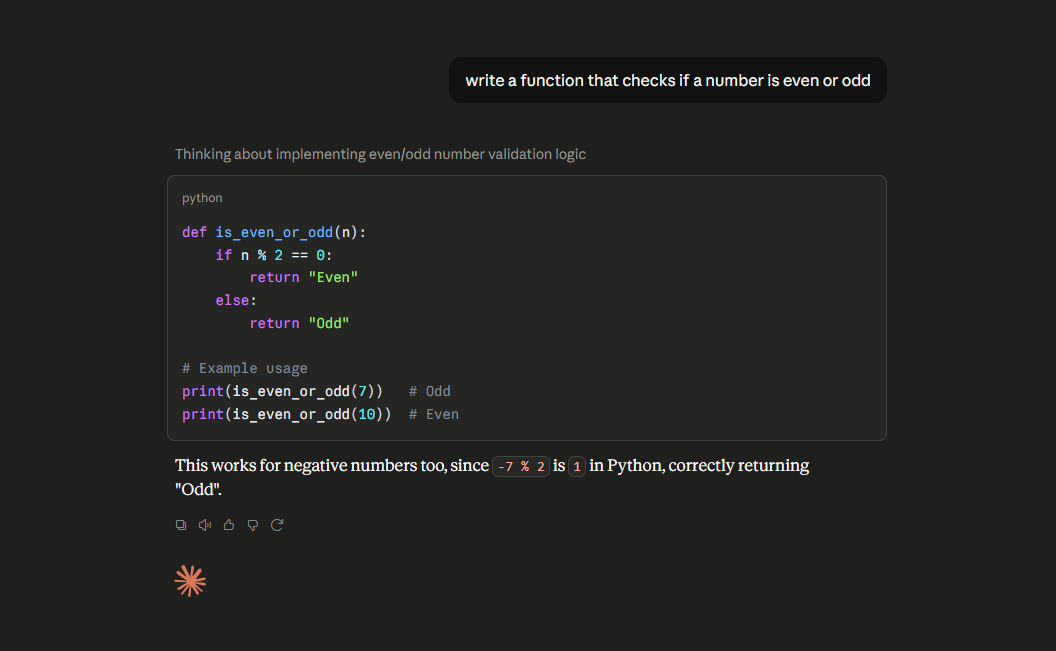
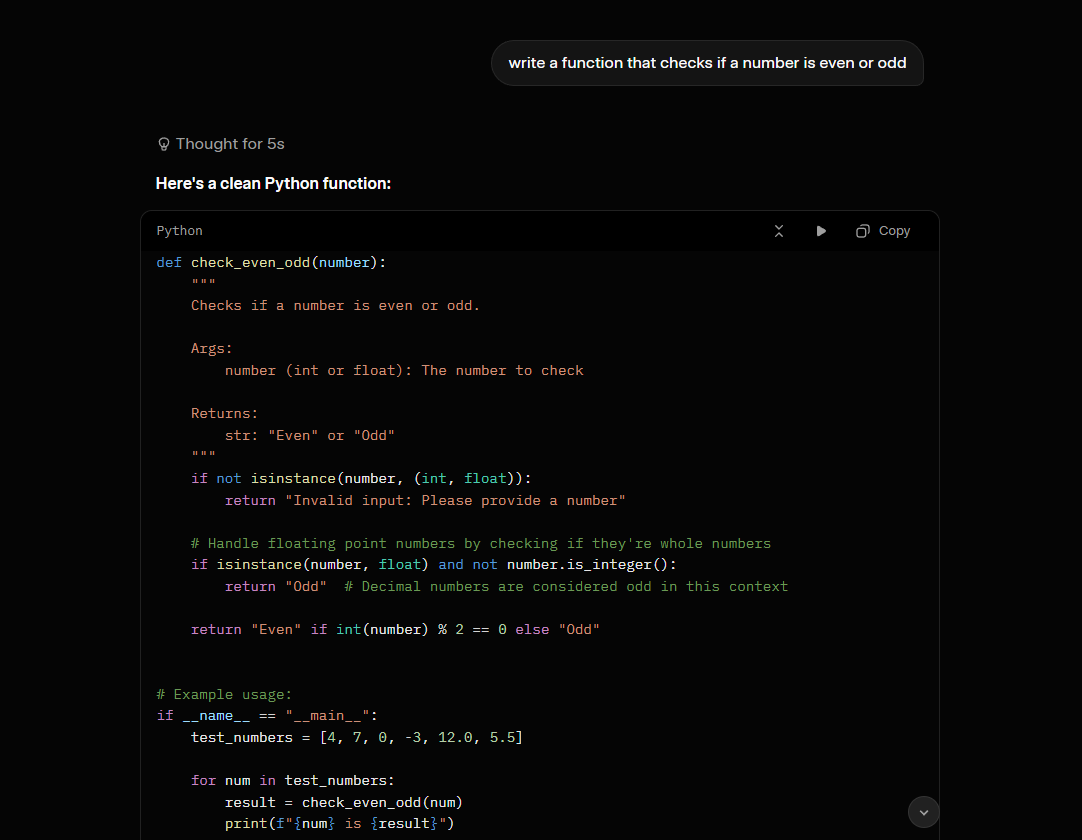
Benchmarks are useful and all, but they don’t really tell you what actually matters, how a model behaves on a normal, everyday coding question. So I ran the exact same prompt through all three: “write a function that checks if a number is even or odd.” Simple on purpose. Here’s what I got back.
Claude Sonnet 5 gave a clean, minimal Python function, then threw in something nobody even asked for, it pointed out that the function correctly handles negative numbers too, since -7 % 2 returns 1 in Python. Small thing, sure, but that’s exactly the kind of edge case that trips up a lot of beginner code, and Claude just caught it on its own.
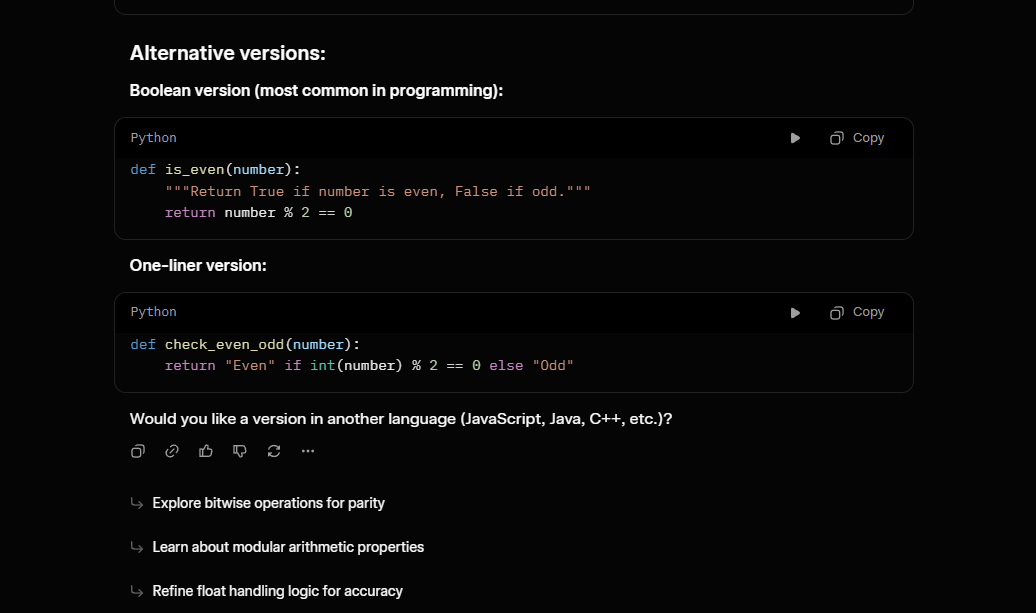
Grok 4.5 went further than the other two, honestly. It didn’t just answer the question, it built in input validation for non-numbers, handled floating-point numbers separately, and then kept going after the main answer to offer two extra versions, a boolean-return version (the style most programmers actually use in real projects) and a compact one-liner. It even asked if I wanted it in another language.
GPT-5.6 Sol kept it simple and practical. Its function worked fine, and it added something the other two didn’t, actual worked example output, showing exactly what the code prints when you run it with real numbers like 8 and 13.
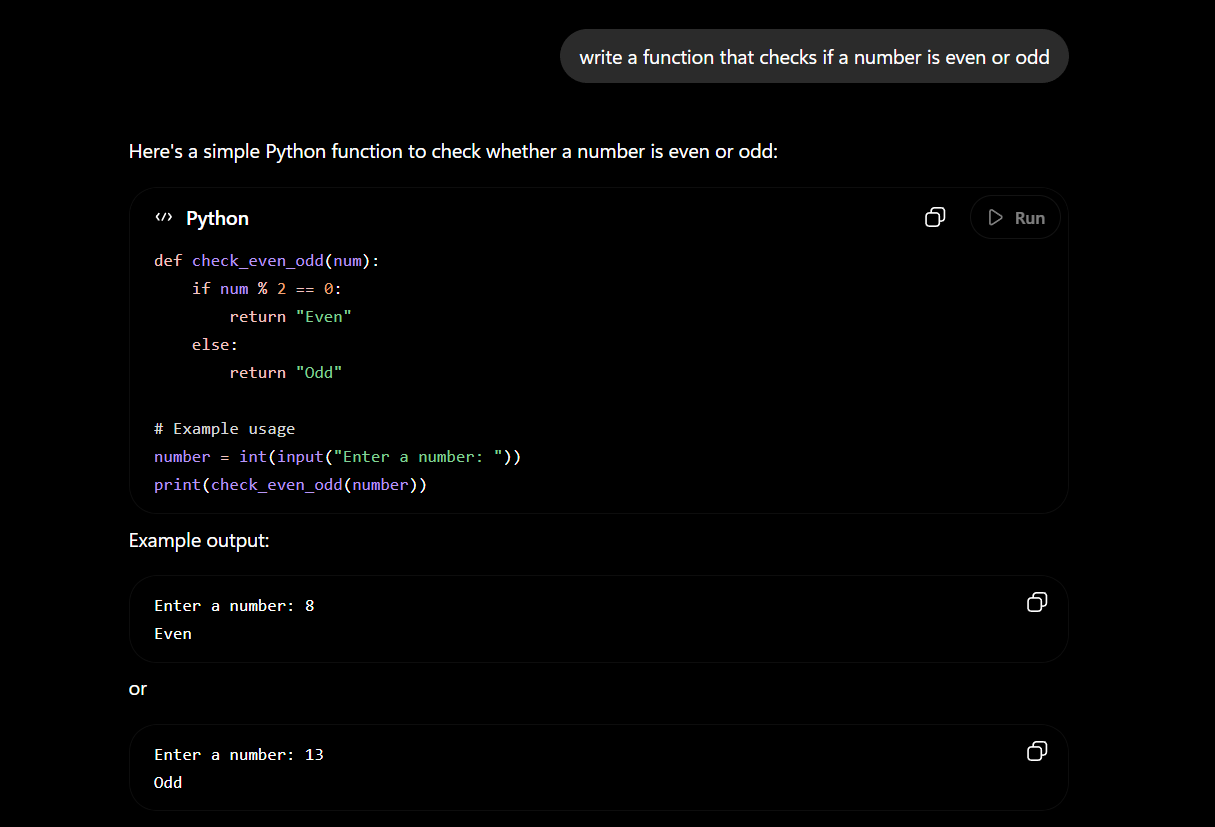
None of the three got it wrong, this was a simple prompt after all. But the real differences show up in how each model thinks past the bare minimum. Claude leaned toward catching hidden edge cases. Grok leaned toward giving you options and just going deeper without being asked. GPT-5.6 leaned toward clarity, actually showing you proof it works. On a harder, real-world coding task, those little personality differences tend to matter way more than they did here.
Pricing Breakdown: Who’s Actually Cheapest?
Marketing pages love throwing around the word “affordable” without ever putting an actual number next to it. So here’s what each model really costs, pulled straight from each company’s own pricing pages.
| Feature | Claude Sonnet 5 | Grok 4.5 | GPT-5.6 Sol |
|---|---|---|---|
| Price (per 1M tokens) | $2 input / $10 output (intro, through Aug 31, 2026); $3/$15 after | $2 input / $6 output | $5 input / $30 output |
| Key Features | 1M token context window at no extra cost, adaptive reasoning effort levels, strong agentic tool use | 1.5T parameter V9 model, trained on real Cursor debugging data, 80 tokens/sec speed, 500K context window | Three-tier family (Sol/Terra/Luna), reasoning-effort ladder up to “max,” new “ultra mode” for subagent coordination |
| Best Use Case | Teams wanting a reliable, well-rounded default for agentic coding and long-context work | High-volume, budget-conscious workloads where speed and cost efficiency matter most | Teams prioritizing raw capability and willing to pay a premium for it |
The numbers actually tell a pretty clear story. Grok 4.5 comes in cheapest of the three, beating Claude on output pricing and undercutting GPT-5.6 Sol by a wide margin. GPT-5.6 Sol sits at the top, roughly three times more expensive than Grok 4.5 on output tokens. Claude Sonnet 5 lands somewhere in the middle, but there’s a real catch here worth knowing about. That $2/$10 pricing is only introductory, and it jumps 50% on both ends starting September 1, 2026, when it moves to $3/$15. So if you’re building a workflow around Sonnet 5 right now, budget for that increase instead of just assuming today’s price sticks around.
One more thing worth flagging, Grok 4.5’s pricing actually doubles once your input goes past 200,000 tokens, so if you’re working with genuinely massive codebases, do the math before assuming it’s automatically the cheapest option for your specific case.
For quick, high-volume, cost-sensitive tasks, Grok 4.5 just wins on price, plain and simple. And if you’d rather not think about a pricing cliff nine weeks from now, that’s worth weighing against Claude’s temporary intro rate.
Grok will be able to call Imagine as a tool in agentic mode for image/video generation. As Imagine keeps improving, this will be amazing for game developers! https://t.co/vqO2bQRLpW
— Elon Musk (@elonmusk) July 8, 2026
The Benchmarks: What the Numbers Actually Show
Every company publishes benchmarks that make their own model look good, that’s just how launches work, honestly. So instead of leaning on any one vendor’s chart, here’s what actually shows up consistently across independent sources like Artificial Analysis and cross-referenced vendor data.
On SWE-Bench Pro, a benchmark that measures how well a model handles real-world software engineering tasks, Claude leads the pack. Grok 4.5 scored 64.7% here, ahead of GPT-5.5 but still behind both Claude Opus 4.8 (69.2%) and Claude’s top-tier model, which topped the whole field at 80.4%. GPT-5.6 Sol wasn’t benchmarked directly on this exact score at launch, but on OpenAI’s own comparison tables, Claude models actually led four separate headline evaluations, including SWE-Bench Pro, while GPT-5.6 Sol’s strongest showing was leading the AA Coding Agent Index specifically.
That’s genuinely interesting, even OpenAI’s own launch materials didn’t crown GPT-5.6 Sol the winner across the board. It won on one specific coding-agent measure while Claude led on several others, which tells you these models aren’t just uniformly better or worse than each other, they’re each better at different specific things.
On DeepSWE 1.1, a benchmark scoring how reliably a model closes real developer-submitted bugs, Grok 4.5 posted 53%, trailing both Claude Opus 4.8 (59%) and GPT-5.5 (67%), with Claude’s top model leading at 70%.
Where Grok 4.5 does actually stand out is efficiency, not raw score. On SWE-Bench Pro tasks, it used roughly 15,954 output tokens per job, compared to about 67,020 tokens for Claude Opus 4.8 on the exact same task, over four times fewer tokens for a slightly lower quality result. That’s really the trade-off Grok is offering, a somewhat lower ceiling in exchange for a dramatically lower cost to get there.
Honest takeaway across every independently sourced benchmark: Claude currently leads on raw coding and agentic quality most consistently, GPT-5.6 Sol is competitive and wins on a couple of specific evaluations, and Grok 4.5 trails both on pure capability but closes a lot of that gap through sheer efficiency and cost.
Token Efficiency: Why “Cheap Per Token” Isn’t the Same as “Cheap Per Task”
Here’s something that trips a lot of people up when they’re comparing AI pricing, the sticker price per million tokens isn’t actually what decides your real cost. What matters is how many tokens a model actually needs to finish the task.
This is where Grok 4.5’s efficiency claims get genuinely interesting. On the Coding Agent Index, Grok 4.5 used an average of 1.9 million total tokens per task, compared to 7.2 million tokens for Claude’s top-tier model in Claude Code and 6.2 million for GPT-5.5 in Codex. So even though Grok’s per-token price isn’t dramatically lower than Claude’s, using nearly four times fewer tokens to get the same task done adds up to real, meaningful savings in practice, not just on paper.
Claude Sonnet 5 has its own little wrinkle here worth knowing about too. It uses an updated tokenizer that can map the same exact text into anywhere from 1.0 to 1.35 times more tokens than its predecessor did. So a workload that looks cheap based on Sonnet 5’s headline price today could quietly end up costing more than you expect once that extra token count kicks in, especially once the introductory pricing runs out in September.
So when you’re actually budgeting for one of these models in a real production setup, don’t just eyeball the per-million-token price on each company’s pricing page. Run your own actual workload, or even just a decent sample of it, through each model and see how many tokens it really takes to get a finished, correct result. A model that costs more per token but wraps up the task in a third of the tokens can easily end up cheaper overall than one with a lower sticker price and a token-hungry style.
So, Which One Actually Wins?
Honestly? There isn’t one universal winner here, and anyone telling you otherwise is oversimplifying.
Claude Sonnet 5 is the safest pick if you want reliable, well-rounded agentic coding without babysitting the model, it caught an edge case unprompted in our own test, and it leads on real benchmarks like SWE-Bench Pro. Grok 4.5 wins decisively on price and speed, it’s the cheapest of the three and built specifically around real developer debugging data, making it a smart choice for high-volume, budget-conscious workflows. GPT-5.6 Sol costs the most by a wide margin, but it backs that up with genuine capability gains and leads OpenAI’s own Coding Agent Index.
If you’re picking based on pure trust and consistency, go Claude. If you’re optimizing for cost at scale, go Grok. If budget isn’t your constraint and you want the newest frontier capability, GPT-5.6 Sol earns its price tag.
FAQ
1. Is Claude Sonnet 5 better than Grok 4.5 for coding? On most independent benchmarks, yeah, Claude Sonnet 5 comes out ahead of Grok 4.5 on things like SWE-Bench Pro and overall coding quality. But Grok 4.5 is way cheaper and faster, so if you’re running high-volume tasks where speed and cost matter more than squeezing out that last bit of quality, Grok can honestly be the smarter pick.
2. Is GPT-5.6 Sol worth switching to from Claude? Depends on your budget, really. GPT-5.6 Sol shows real capability gains and even beats Claude on OpenAI’s own Coding Agent Index, but it costs a lot more per million tokens than Claude Sonnet 5. If cost isn’t a big deal for you and you want the newest frontier capability, it’s worth testing against your own workloads.
3. Which AI model is cheapest for coding tasks? Grok 4.5 has the lowest output pricing at $6 per million tokens, compared to Claude Sonnet 5’s $10 (during its intro period) and GPT-5.6 Sol’s $30. For high-volume, budget-tight workloads, Grok 4.5 is currently your best price-to-performance option.
4. Is Grok 4.5 good for developers? Yeah, especially for cost-sensitive, high-volume coding work. It was trained using real debugging sessions from Cursor, it’s fast, and the pricing makes it genuinely appealing for teams running tons of iterations. It’s not leading on raw intelligence benchmarks, but its efficiency is a real strength.
5. What’s the difference between GPT-5.6 Sol, Terra, and Luna? Sol is OpenAI’s flagship, the most powerful and most expensive one. Terra’s the mid-tier option, balancing capability and cost. And Luna’s the cheapest, lightest version meant for high-volume, simpler tasks. Basically good, better, best, just priced and named in reverse order.
3 thoughts on “Gpt 5.6 vs Grok 4.5 vs Claude: Which is better?”