

Should You Trust Meta’s AI Agents After Zuckerberg’s Admission?
Quick Answer: Zuckerberg told staff AI agents “hasn’t really accelerated” in 4 months. Minutes later, his AI chief claimed Meta’s unreleased “Watermelon” model already beats GPT-5.5, with zero benchmarks shown. The stock dropped 4.9% that day, then rallied 15% over the next week on separate news. Trust the admission, treat the claim as unverified until Meta actually ships something.
Okay, so this is one of those stories where the contradiction is basically the whole point. On July 2, 2026, Mark Zuckerberg stood in front of Meta employees at an internal town hall and said, in a recording later heard by Reuters, that the “trajectory of the agentic development over at least the last four months hasn’t really accelerated in the way that we expected.” He also admitted the reorganization behind roughly 8,000 layoffs “haven’t come to fruition yet” and that the whole thing wasn’t as “clean” as it should’ve been.
Minutes later, in that same room, his AI chief Alexandr Wang told employees a very different story, that Meta’s next model, codenamed Watermelon, has already “caught up” with OpenAI’s GPT-5.5 on internal benchmarks. He didn’t share which benchmarks. Meta hasn’t published anything. Nobody outside that room has independently verified a single number.
So you’ve got a CEO admitting real, specific failure, and an AI chief claiming a real, specific win, in the same meeting, minutes apart. That’s not spin, that’s an actual contradiction, and it’s exactly why this story’s worth more than just a quick news recap.
Here’s what makes it genuinely interesting to actually dig into, this isn’t where the story ends either. Meta’s stock dropped nearly 5% the day this all became public. Then, over the following week, it rallied hard, up 15%, its best week since early 2024, on a completely different set of announcements. So the honest question worth actually answering is, after all of that, should you trust what Meta says about its AI agents? Let’s actually walk through it.
What Actually Happened at That Town Hall
Let’s get the actual sequence straight, because a lot of coverage blurs the timing.
On Thursday, July 2, 2026, Zuckerberg told Meta staff that AI agent development hadn’t accelerated the way executives expected over “at least the last four months.” He traced the whole restructuring back to conversations he’d had in January and February with senior people who worried Meta “weren’t going to move fast enough to adapt.” At the time, he said, executives were “super optimistic” about tools like Claude Code, Anthropic’s agentic coding tool, and expected that same speed to carry into Meta’s own products. It hasn’t, by his own account.
He didn’t stop there either. Zuckerberg admitted the reorganization, which included cutting about 8,000 jobs (roughly 10% of Meta’s global workforce) and reassigning another 7,000 employees onto AI-focused teams, wasn’t as “clean” as it could’ve been, and that he’d made mistakes in the workforce shift and would “almost certainly make more.” He put a real number on when he expects things to actually turn around, three to six months, which pushes any real payoff toward the end of 2026.
Minutes later, still in the same room, AI chief Alexandr Wang delivered a completely different tone. He told employees Meta’s upcoming Watermelon model, trained on “an order of magnitude” more compute than its predecessor (internally called Avocado, publicly released as Muse Spark), had already matched GPT-5.5’s performance on internal benchmarks. When someone asked when Meta would have a coding model competitive with Anthropic’s Claude Opus, Wang said “pretty soon” and told people they’d like what the company has “cooking.”
That’s the actual sequence. One executive admitting a real, specific delay with real, specific numbers behind it. Another executive, minutes later, making a big, specific claim with zero numbers behind it. Worth sitting with that contrast before deciding how much weight to give either half.
Is the Watermelon Model Actually Better Than GPT-5.5?
Here’s the honest answer, nobody outside that Meta town hall actually knows yet, and that’s not a dodge, it’s just the actual state of the evidence.
Wang’s claim rests entirely on unnamed “internal benchmarks.” He didn’t specify which ones, didn’t share numbers, and Meta hasn’t published anything publicly. Meta also declined to comment when reporters followed up, and OpenAI didn’t respond to requests for comment either. So what you’re actually being asked to believe is a verbal claim from a company executive, made in a room full of employees Meta’s trying to reassure after a rough stretch of layoffs and reorg pain.
There’s a real pattern worth knowing here too, and it’s honestly not flattering. Meta’s Muse Spark model, the one that shipped in April, was described at the time as performing well on benchmarks but still falling short of rivals. Before that, Llama 4 was widely considered a relative disappointment after Llama 3.x had genuinely been competitive. So this isn’t the first time Meta’s told a confident story about catching up that didn’t fully hold up once the model actually shipped and got independently tested.
That said, it’s not all skepticism. One detail worth knowing, an independent research firm called SemiAnalysis, which isn’t affiliated with Meta, published a report card on Meta’s AI restructuring that same week and gave it genuinely positive marks, calling the reorganized Meta Superintelligence Labs team “an extremely underappreciated advantage,” while also being clear that “they are still basically at step 1.” That’s a real, independent, somewhat bullish read sitting right alongside all the internal skepticism, worth including for balance rather than only quoting the doubters.
Honest read here, Watermelon might genuinely be good. Meta clearly has the compute and the talent to make real progress. But “an executive said so in a meeting” isn’t evidence, it’s a claim, and Meta’s own recent track record (Llama 4, Muse Spark) gives you real reason to wait for actual, independently verified benchmarks before updating your opinion.
The Claude Code Irony Nobody’s Talking About
This detail’s genuinely worth its own section, because it’s the kind of thing that gets buried in the middle of longer news stories but actually says a lot.
Zuckerberg specifically named the tool that made his own executives “super optimistic” back in January and February, Claude Code, Anthropic’s agentic coding tool. In other words, the reorganization that laid off 8,000 people and reassigned 7,000 more was partly inspired by watching a competitor’s product work well, and Meta bet it could replicate that speed internally. By Zuckerberg’s own account, it hasn’t happened yet.
That irony didn’t go unnoticed by the developer community either. On Hacker News, in a thread specifically discussing this story, one commenter responded to the Claude Code detail with a line that’s stuck with a lot of people who read it:
💬 Expert quote,: Hacker News user nitwit005 wrote, in response to the “super optimistic about tools like Claude Code” detail: “Some guy in sales at Anthropic has a new yacht though.” https://news.ycombinator.com/item?id=48767058
It’s a joke, but it lands because it’s pointing at something real, Meta spent months and thousands of jobs trying to replicate what a competitor had already built, and by the CEO’s own admission, still hasn’t gotten there. If you’re deciding which agentic coding tool to actually build your own workflow around right now, that’s a genuinely relevant data point, not just a punchline. Our Claude Sonnet 5 developer review covers what that inspiration point, Claude Code, actually looks like in practice today.
There’s one more admission worth adding here that most coverage of this story missed entirely. Meta’s CTO, Andrew Bosworth, separately told employees the company’s AI reorg had been “atrocious,” a word choice that’s honestly even harsher than anything Zuckerberg said publicly. When your CEO and your CTO are both using words like “not clean” and “atrocious” to describe the same restructuring, that’s not spin, that’s two of the most senior people at the company agreeing something genuinely went wrong.
Why the Stock Dropped, Then Rallied 15% a Week Later
This is the part almost every other article covering this story leaves out entirely, probably because it happened over the following week rather than in the same news cycle.
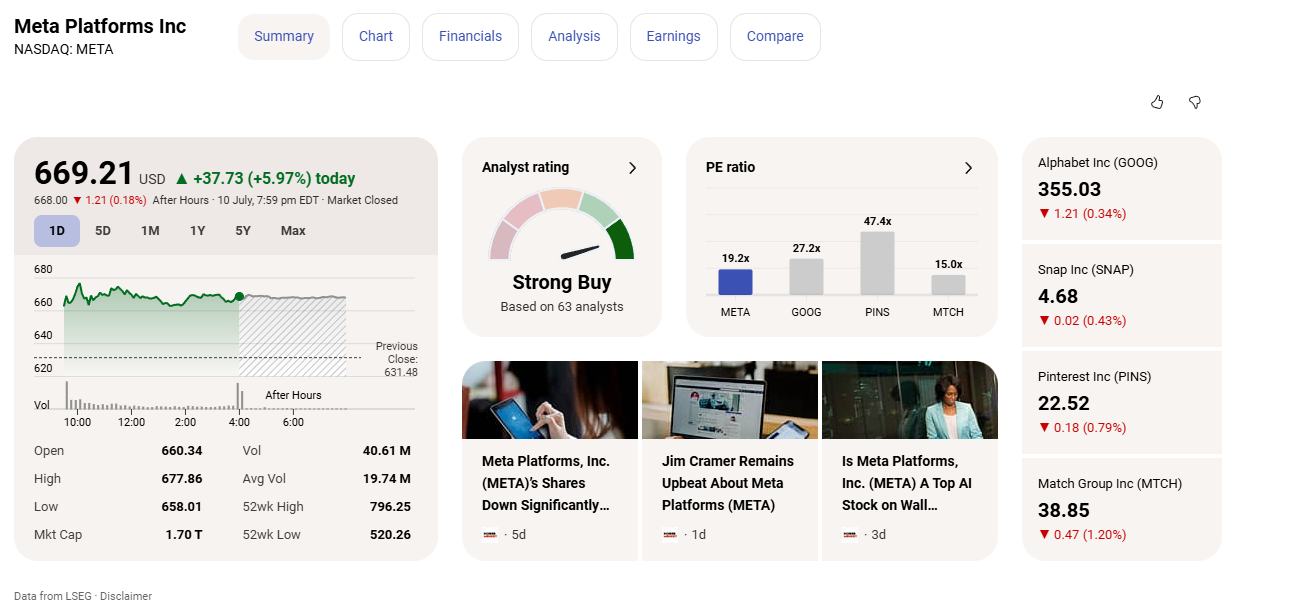
Meta’s stock dropped 4.9% on the day the Watermelon claim and Zuckerberg’s admission both became public, landing at around $582.90. That’s a real, immediate market reaction to genuine uncertainty, investors weren’t thrilled about an unverified claim sitting next to a real admission of delay.
But that’s not where the story ends. Over the following week, Meta’s stock rallied hard, climbing roughly 20% from its late-June lows into the $660-680 range, its best single week since early 2024. Checking the actual numbers as of July 10, Meta closed at $669.21, up 5.97% that day alone, after touching highs above $677.
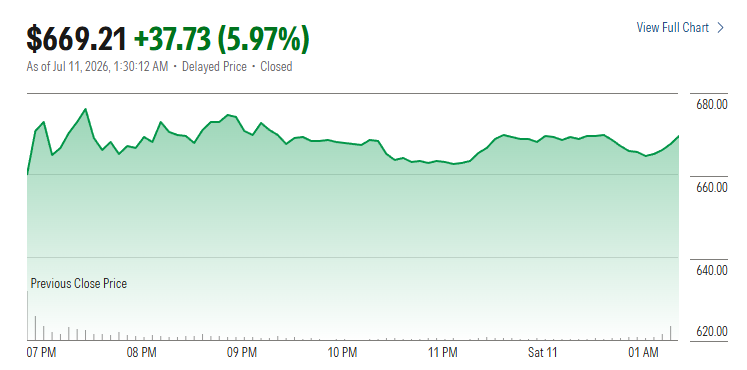
So what actually drove that recovery? Not Watermelon, it still hasn’t shipped. It was a separate string of announcements, Meta unveiled a new cloud business called Meta Compute, aiming to sell AI compute and models directly, putting it in competition with AWS, Azure, and Google Cloud for the first time. Meta also released Muse Image, a new AI image generation model, and rolled out an update to Muse Spark aimed at coding and agentic workloads. On top of that, Meta confirmed plans to start producing its own in-house AI chip, codenamed Iris, starting in September 2026, targeting 14 gigawatts of compute capacity. And that SemiAnalysis report card mentioned earlier landed the same week too, giving investors an independent, semi-bullish read right when they needed one.
Honest takeaway here is genuinely nuanced, and it’s the reason this story is more interesting than a single day’s headline. Investors punished the unverified Watermelon claim immediately, but they rewarded concrete, shippable progress (a new product, a new business line, a real chip timeline) within days. That’s actually a pretty healthy market signal, claims without evidence get discounted, real releases get rewarded, even from the same company in the same week.
What This Means for Anyone Building on Meta’s AI Tools
Here’s the part that actually matters if you’re a developer, business, or investor trying to decide what to do with this info, not just read about it.
If you’re a developer choosing between agentic coding tools right now, the honest signal is, Meta’s own leadership admits their internal agent tooling isn’t where they wanted it to be, four months of stalled progress by the CEO’s own account. Meanwhile, the tool that inspired their entire reorg, Claude Code, is already shipping and already being used in production by teams outside Meta. If you need something working today, that’s a meaningful data point in favor of what’s actually available now.
If you’re weighing Meta stock as an investor, the nuance matters more than either headline alone. The 4.9% drop tells you the market doesn’t take unverified executive claims at face value. The 15% weekly rally tells you the market does reward real, shippable progress, cloud business plans, actual model releases, real chip timelines. Betting purely on “Watermelon will beat GPT-5.5” is speculative until Meta actually publishes real benchmarks. Betting on Meta’s broader AI infrastructure buildout (Meta Compute, the Iris chip, its existing ad business) has more concrete evidence behind it right now.
And there’s a bigger structural point worth understanding too, one that most coverage of this story skipped. AI agents aren’t just a feature Meta’s trying to ship, they’re supposed to be the mechanism that turns a 3.2-billion-person social network into something more like a commerce and transaction layer, not just an ad-attention business. If a Meta agent helps you book a trip or buy furniture, Meta captures a transaction signal, not just a scroll. That’s a genuinely different, more durable business model than what Meta runs today. The longer the agent timeline slips, the longer Meta stays dependent on the ad-attention model it’s trying to move beyond, which is a bigger deal than a single delayed feature.
For a wider view of how Meta’s current AI lineup, including Watermelon’s predecessor, actually stacks up against the competition, our GPT-5.6 vs Grok 4.5 vs Claude comparison covers the current frontier-model landscape Watermelon would actually need to compete in once it ships.
So, Should You Trust Meta’s AI Agents Right Now?
Honestly, partially, and the specific split matters more than a simple yes or no.
Trust the admission. Zuckerberg’s statement was specific, self-critical, and backed by real numbers, 8,000 layoffs, $145 billion in planned spending, a four-month stall. CTO Bosworth calling the reorg “atrocious” backs that up further. Companies don’t usually volunteer that level of candor unless it’s genuinely true, so that half of the story deserves real weight.
Don’t trust the Watermelon claim yet, not because it’s necessarily false, but because it’s currently unverifiable. No benchmarks, no release date, no independent confirmation, and Meta’s own recent track record (Llama 4, Muse Spark) gives you real reason to wait rather than assume. If you need an agentic tool that works right now, Meta’s own leadership is telling you, in their own words, that it’s not there yet.
The stock rally is real and worth understanding on its own terms, it wasn’t investors buying the Watermelon story, it was investors rewarding Meta Compute, Muse Image, and the Iris chip timeline, genuine, shippable progress that has nothing to do with the unverified benchmark claim. Separate the two stories, and you get a much clearer, more useful picture than either headline gives you alone.
FAQ
1. Should I trust Meta’s AI agents after Zuckerberg’s admission? Trust the admission itself, it was specific and self-critical, backed by real numbers on layoffs and spending. Don’t trust the separate claim that Meta’s Watermelon model beats GPT-5.5 yet, since that’s got zero published benchmarks or independent verification behind it.
2. Is Meta’s Watermelon model actually better than GPT-5.5? Nobody outside Meta’s internal town hall knows for sure. AI chief Alexandr Wang claimed it matches GPT-5.5 on unspecified internal benchmarks, but Meta hasn’t published any data, and the model hasn’t even been released or independently tested yet.
3. Why did Meta lay off 8,000 workers for AI? Meta’s leadership believed AI agents could absorb work that used to require human employees, so the company cut about 8,000 jobs (10% of its global workforce) and reassigned roughly 7,000 more onto AI-focused teams. Zuckerberg later admitted this bet “hasn’t come to fruition yet.”
4. Is Meta stock worth buying after the AI agent delay news? The stock dropped 4.9% on the initial news, then rallied 15% over the following week on separate announcements (a new AI cloud business, new model releases, and an in-house AI chip timeline). That split suggests investors are rewarding real, shippable progress rather than the unverified Watermelon claim specifically.
5. Is Claude Code better than Meta’s AI agents for developers? Based on Meta’s own account, its executives were inspired by Claude Code’s speed and built their entire reorganization around trying to match it, but by Zuckerberg’s own admission, they haven’t gotten there after four months. Claude Code’s already shipping and already in production use today, which is a meaningful practical advantage if you need something working right now.
- Claude Sonnet 5 for Developers Review: Security & Coding Breakdown, a look at the tool that reportedly inspired Meta’s entire AI reorganization.
- GPT 5.6 vs Grok 4.5 vs Claude: Which Is Better?, the current frontier-model landscape Watermelon will need to compete in once it actually ships.
- Is Meta Muse Image Worth It? Honest AI Review, one of the real, shipped Meta AI products that actually helped drive last week’s stock rally.
- Is AI Agent Freelancing Actually Worth It? Honest Take, useful context on how agentic AI performs in the real world versus how it’s marketed.
Related Web Stories:
- Claude vs Grok 4.5 vs GPT-5.6: Who Wins?
- Meta Just Put AI Image Gen in Your Instagram
- Claude Just Asked Me for My ID 😳