
Is Claude Science Worth It for Researchers? (First Review)
Quick Answer: Claude Science is genuinely promising for computational research, especially life sciences, since it bundles 60+ databases, real compute management, and citation-checking into one workspace. But it’s still beta, Mac/Linux only, and gated behind Pro/Max/Team/Enterprise. Worth trying if you’re already in that ecosystem, not worth switching your whole workflow for yet.
Okay, so here’s the thing about doing actual research. It’s rarely just “have an idea, run an experiment, get an answer.” It’s PubMed in one tab, a Jupyter notebook in another, a terminal window connected to some cluster you’re praying doesn’t time out, and a spreadsheet somewhere trying to keep it all straight. Most of the actual time in science doesn’t go into thinking, it goes into wrangling tools that were never designed to talk to each other.
So when Anthropic dropped Claude Science on June 30, 2026, and called it an “AI workbench for scientists,” that promise was pretty specific: stop bouncing between a dozen disconnected tools, and just do the research in one place instead.
Here’s what makes this one actually worth paying attention to, though. Anthropic went out of their way to say Claude Science isn’t a new model. It’s not some special biology-tuned version of Claude that only a few labs get to touch. It runs on the same Claude Opus 4.8 anyone can already access, the thing that’s new is everything wrapped around it, the database connections, the compute management, the reproducibility tracking. That’s a genuinely different bet than what OpenAI and Google are making with their own science tools.
And the timing matters too, honestly. This launched right as Anthropic was working through the fallout of the Fable 5 export control shutdown, and just days before it, in the middle of a pretty wild stretch overall. Claude Science is quieter than most of that news, but it might end up mattering more long-term, especially if you’re someone who actually spends your days doing computational research instead of just reading about AI headlines.
So is it actually worth using? Is it worth paying for Claude Max just to get access? And how does it really stack up against Google’s and OpenAI’s competing bets? Let’s get into what Claude Science actually is, and whether it lives up to the pitch.
What Is Claude Science, Exactly?
Claude Science launched on June 30, 2026, and Anthropic describes it as an AI workbench built specifically for scientists. But before getting into what it does, it’s worth being clear about what it isn’t.
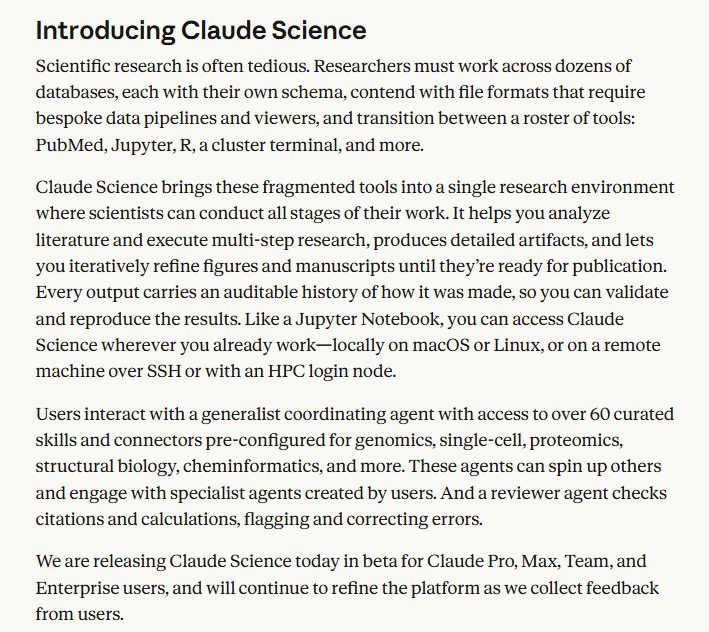
Anthropic’s actually pretty upfront about this: Claude Science is not a new AI model. It runs on the exact same Claude models everyone already has access to, including Claude Opus 4.8, no special or gated version underneath. What’s actually new is the harness around that model, the connections, the tools, the memory, all the scaffolding that turns a general-purpose AI into something built specifically for lab work.
Here’s the problem it’s trying to solve. Scientific research is genuinely tedious in a way that has nothing to do with the actual science. Researchers bounce between dozens of databases, each with its own format, switch between tools like PubMed, Jupyter, R, and a cluster terminal, and keep rebuilding the same kinds of data pipelines from scratch. Claude Science tries to bring all of that into one place instead.
Practically, it connects to more than 60 scientific databases right out of the box, with prebuilt toolkits for fields like genomics, single-cell biology, proteomics, structural biology, and cheminformatics. It also integrates NVIDIA’s BioNeMo Agent Toolkit, which connects it natively to specialized life-sciences models like Evo 2, Boltz-2, and OpenFold3, so it’s not just databases, it’s plugged into other purpose-built biology models too. It can analyze scientific literature, run multi-step research tasks, and generate figures and manuscripts alongside the actual code that produced them, so every result comes with a trail back to exactly how it was made.
It’s also built to be visual in a way a normal chat window isn’t. It natively renders things like 3D protein structures, genome browser tracks, and chemical structures, rather than just describing them in text. And every output ships with what Anthropic calls a reproducibility package, the code, the environment, a plain-language explanation, and the full message history, so another researcher (or you, months later) can actually verify how a result was produced.
Right now, Claude Science is in beta, and it’s primarily aimed at life sciences research, though the general architecture is built to expand into other fields down the line.
How It Actually Works
Reading Anthropic’s description of Claude Science is one thing. Seeing the actual interface is another, and it tells you a lot more about how this is meant to be used day to day.
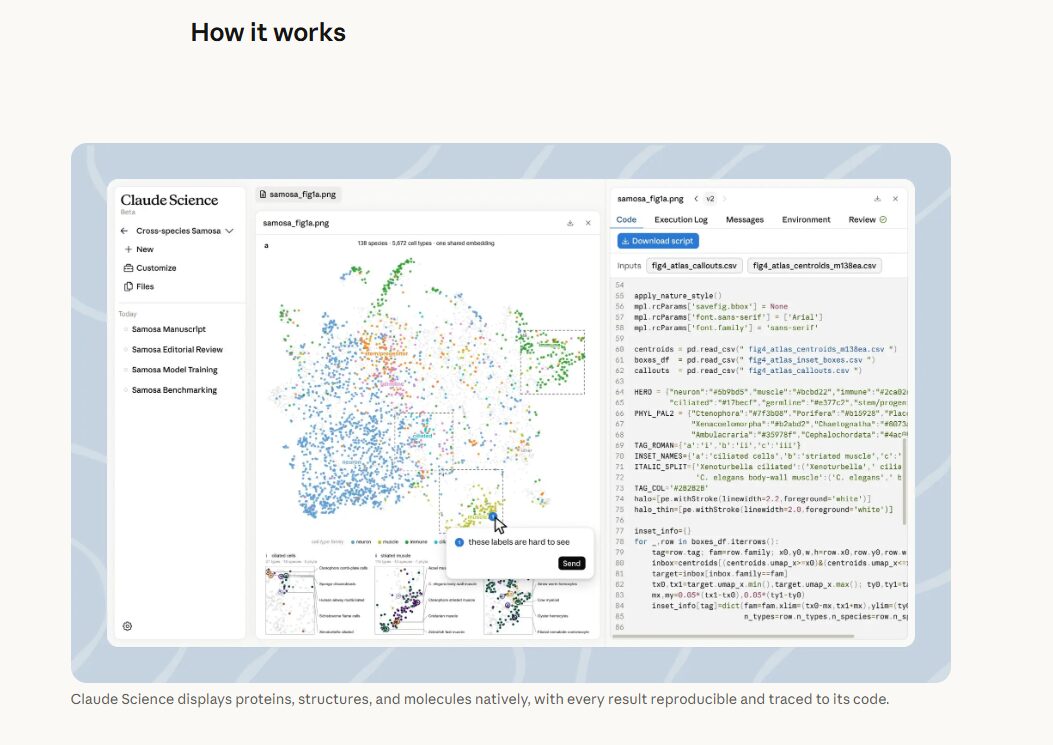
Looking at the real interface, it’s laid out in three columns, and the structure says a lot about how Anthropic wants scientists to actually work. On the left, there’s a running list of past sessions, in the example shown, projects like “Samosa Manuscript,” “Samosa Editorial Review,” “Samosa Model Training,” and “Samosa Benchmarking,” organized under a single research project. That’s a meaningfully different setup than a normal chat history, it’s built around ongoing, named research threads instead of one-off conversations you lose track of.
The center panel shows the actual scientific output, in this case a cross-species cell-type visualization plotting thousands of cells across more than a hundred species, all grouped by shared traits like neurons, muscle, and stem cells. It’s genuinely dense, visual scientific data, not a chatbot summary of it.
The right panel is where the “auditable” part of Claude Science actually shows up in practice. It displays the real code that generated the figure on screen, including specific file references like fig4_atlas_centroids_m138ea.csv and fig4_atlas_callouts.csv, along with tabs for Execution Log, Messages, Environment, and Review. That Review tab lines up with what Anthropic says about its reviewer agent checking citations and calculations before anything’s considered publication-ready.
There’s also a small but telling detail in the screenshot, a chat bubble reading “these labels are hard to see,” sitting right on the visualization itself. That matches what Anthropic describes as being able to annotate figures in-line and have the agent revise its own code based on plain-language feedback, rather than you having to dig back into the code yourself to fix a small formatting issue.
Put together, this isn’t a chatbot with a science skin on it. It’s closer to a real research environment, code, data, visualization, and review all sitting in the same window, with a full trail connecting the final figure back to exactly how it was made.
Who Can Actually Access It (And What It Costs)
This is where a lot of people get tripped up, so let’s break it down clearly.
Claude Science is available in beta to anyone on Claude Pro, Max, Team, or Enterprise, no special vetting or waitlist required, which is genuinely different from how OpenAI’s competing tool works. If you’re on Team or Enterprise, though, your admin needs to actually flip it on first, it’s not automatically live for every seat.
Here’s what those plans actually cost, since most coverage skips the real numbers. Pro runs $17/month if you pay annually, or $20/month billed monthly. Max starts at $100/month. Team standard seats are $20/seat/month annually or $25/month billed monthly, and Team premium seats run $100/seat/month annually or $125/month. Enterprise pricing depends on your specific plan and usage, so that one requires talking to sales directly. Anthropic’s also offering discounted Team plans specifically for academic labs and nonprofit research organizations, worth asking about if you’re at a university.
One real limitation right now, Claude Science only supports macOS 13 or later and Linux (x64). There’s no Windows support in the initial release, so if your lab runs entirely on Windows machines, you’re out of luck for now, at least until Anthropic expands platform support.
And here’s a detail worth knowing if you’re thinking about applying: Anthropic is funding up to 50 “AI for Science” research projects with up to $30,000 in compute credits each, plus up to $2,000 in additional compute from Modal for select projects. Applications close July 15, 2026, with award notifications by July 31, and funded projects run September 1 through December 1, 2026. If you’re a postdoc or grad student and this sounds relevant, that deadline is coming up fast.
Claude Science vs. Gemini for Science vs. GPT-Rosalind
Here’s how the three major players’ science tools actually stack up, built from public information since none of these are things anyone outside a vetted beta group has personally tested hands-on beyond what’s publicly documented.
| Feature | Claude Science (Anthropic) | Gemini for Science (Google) | GPT-Rosalind (OpenAI) |
|---|---|---|---|
| What It Is | A workbench/harness built around existing Claude models, not a new model itself | A workbench bundling Google’s own proprietary science models (like AlphaFold, AlphaGenome) plus 30+ life science databases | A specialized model fine-tuned specifically for biological reasoning |
| Access | Beta, available to all Pro, Max, Team, and Enterprise subscribers, no special vetting required | Launched at Google I/O 2026, bundled into Google’s science-focused offerings | Research preview, limited to qualified enterprise customers only |
| Underlying Model | Same general-purpose Claude models everyone already uses (including Opus 4.8) | Google’s own proprietary foundational science models, not available to competitors | A dedicated, specialized model built just for biology |
| Best Use Case | Labs already using Claude who want one workspace for literature review, analysis, and compute management | Teams wanting access to Google’s proprietary structural biology models specifically | Enterprise pharma/biotech teams who can get vetted access and want a purpose-built biology model |
Honest note on the strategy difference here, since it’s genuinely the most interesting part of this whole story: Anthropic’s betting on broad access with a workflow layer wrapped around models everyone already has. Google’s betting on owning proprietary models nobody else can touch, and its credibility here is real, DeepMind’s Demis Hassabis and John Jumper actually won a Nobel Prize in Chemistry in 2024 for AlphaFold. OpenAI’s betting on a narrow, gated specialist model instead of a broad workbench. Three very different approaches to the same emerging market, and it’s genuinely too early to say which one wins.
One more twist worth knowing, John Jumper, the AlphaFold Nobel laureate himself, announced on June 19, 2026 that he’s actually leaving DeepMind to join Anthropic, though his specific role hasn’t been disclosed yet. That’s a pretty significant vote of confidence in whichever direction Anthropic decides to take this.
What Real Researchers Are Actually Saying
Beyond Anthropic’s own marketing, there’s genuine third-party evidence worth looking at, actual named researchers who used this during the beta period and talked about real results.
Jérôme Lecoq, a neuroscientist at the Allen Institute, used Claude Science to build a multi-agent “computational review template” made up of about 20 custom skills geared toward writing long-form literature reviews. Sub-agents read through thousands of papers, pull out the central claim and key quantitative finding from each, and store them in a shared evidence database. Then the pipeline builds a narrative arc and writes the review section by section, with a separate reviewer agent checking each section for accuracy and citation fidelity as it goes. Before Claude Science, Lecoq’s team said a review like this could take up to two years. Now they’re producing 100-page reviews with agent-checked citations in a fraction of that time.
Stephen Francis, an associate professor and epidemiologist at UCSF Brain Tumor Center, used Claude Science for germline variant analysis in glioma research, basically studying how thousands of small-effect genetic variants combine to shape someone’s individual cancer risk. His team completed comprehensive analysis in roughly one-tenth of the time it previously took, and importantly, they independently validated the results themselves rather than just taking the tool’s word for it.
💬 Expert quote: Stephen Francis told pharmaphorum: “After months of beta testing Claude Science, I’m convinced. This tool is going to accelerate scientific discovery in a big way.”
Two more named case studies worth knowing about. Manifold Bio used Claude Science end-to-end to nominate drug targets for actual lab experiments, assessing things like surface expression and trafficking safety against their own proprietary data. And Claude Science comes preloaded with access to Basecamp Research’s EDEN dataset, described as the world’s largest biological dataset, pulling sequencing data from millions of different microbe species. According to its developer, EDEN can compress several weeks of research per pathogen down into a single Claude conversation, which is a genuinely wild claim if it holds up at scale.
Taken together, these aren’t vague “AI is amazing” testimonials, they’re specific people, specific institutions, and specific time savings, which is honestly more convincing than most product launch claims tend to be.
For context on how Anthropic’s broader model lineup compares heading into this, our Claude Sonnet 5 developer review covers the same underlying Claude models Claude Science is built on top of, and our GPT-5.6 vs Grok 4.5 vs Claude comparison has our full breakdown of how Claude stacks up against GPT and Grok more broadly, useful background if you’re deciding how much to trust the underlying model powering all of this.
So, Is Claude Science Worth It for Researchers?
For most computational research teams, yeah, with a few real caveats. Score: 4/5
It’s worth it if you’re already inside the Claude ecosystem and doing genuine computational work, genomics, proteomics, literature reviews spanning hundreds of papers, or anything that has you bouncing between PubMed, Jupyter, and a cluster terminal all day. The beta results from Allen Institute, UCSF, and Manifold Bio are real and specific, not vague marketing claims, and the reproducibility packaging alone solves a problem most AI research tools just ignore entirely.
It’s not worth it yet if you’re on Windows, since it’s Mac/Linux only right now, or if your field falls outside life sciences, since that’s where all 60+ database connections and the NVIDIA BioNeMo integration are currently pointed. Casual or non-technical researchers dabbling occasionally should also wait, this is built for people already doing serious computational work, not casual scientific Q&A. And this is the same kind of worth-it math we ran for AI agent freelancing, it’s a real accelerant for people already doing the work, not a replacement for the underlying skill.
FAQ
1. Is Claude Science worth it for researchers? For labs already doing computational research, especially in life sciences, yeah. It bundles literature analysis, database access, compute management, and citation checking into one place, saving real time on the tool-switching that eats up most research days.
2. Do I need Claude Max to use Claude Science? No, you don’t need Max specifically. Claude Science is available in beta to anyone on Pro, Max, Team, or Enterprise plans, though Team and Enterprise users need their admin to enable it first.
3. Is Claude Science a new AI model? No, and Anthropic’s pretty upfront about this. It runs on the exact same Claude models everyone already has access to, including Claude Opus 4.8, the workbench itself is what’s new, not the underlying intelligence.
4. Can Claude Science run on Windows? Not currently. As of its June 30, 2026 launch, Claude Science only supports macOS 13 or later and Linux, Windows support wasn’t included in the initial documentation.
5. How is Claude Science different from Gemini for Science? The core difference is what’s underneath. Claude Science runs general-purpose Claude models with a research harness wrapped around them, while Gemini for Science bundles Google’s own proprietary science models, like AlphaFold, that only Google has access to.
- Claude Sonnet 5 for Developers Review: Security & Coding Breakdown, the same underlying Claude models Claude Science is built on top of.
- GPT 5.6 vs Grok 4.5 vs Claude: Which Is Better?, our full breakdown of how Claude stacks up against GPT and Grok.
- Is AI Agent Freelancing Actually Worth It? Honest Take, the same kind of worth-it math applied to a different corner of the Claude ecosystem.
- Claude Government ID Verification: What It Means (2026), a look at another thread of scrutiny Anthropic’s been navigating this year.
Related Web Stories:
- Claude vs Grok 4.5 vs GPT-5.6: Who Wins?
- Claude Just Asked Me for My ID 😳
- Meta Just Put AI Image Gen in Your Instagram