

Is AI Agent Freelancing Actually Worth It? (The Honest Answer)
Quick Answer: Yeah, it’s worth it, but not the way the hype claims. Real AI agent freelancers earn $75-300/hour, but it takes 3-6 months to actually build momentum, not 30 days like some sales page wants you to believe. Works best if you already have a skill AI can speed up, not as some shortcut to passive income out of thin air. Expect real work, not magic.
Okay, so if you’ve spent any time on Twitter or YouTube lately, you’ve probably seen it. Someone with a slick thumbnail, a screenshot of a bank balance, and a headline like “I made $47,000 last month with AI agents, here’s how.” They make it sound like you just point some software at a problem, walk away, and money starts showing up.
And look, AI agents are real, they’re not hype in the sense that the tech doesn’t work. Businesses genuinely need people who can build lead-qualification bots, automate customer service, or wire together workflows that used to take a human hours to do by hand. That part’s true. What’s murkier is everything wrapped around it, the implied timeline, the implied effort level, and especially the implied income.
So here’s the question worth actually answering honestly, if you stripped away the screenshots and the “six figures in six months” claims, what does AI agent freelancing actually look like? Who’s really making money doing this? How much, realistically, and how fast? And just as important, what does it actually take, day to day, to get there, because “AI does the work for you” and “AI helps you do the work faster” are two very different pitches, and only one of them is true.
That’s what this article’s actually about. Not another breathless “AI agents are the future” piece, and not a cynical “it’s all fake” takedown either. Just a real look at the actual rate data, the actual timelines people report, and the actual gap between what gets promised in a course sales page and what shows up in someone’s bank account three months in.
If you’re seriously considering this as a way to make money, you deserve the version without the hype filter. Let’s get into it.
What “AI Agent Freelancing” Actually Means
Before getting into numbers, it helps to get clear on what this actually is, because a lot of the confusion around AI agent freelancing comes from people mixing it up with something else entirely.
AI agent freelancing isn’t the same thing as “using ChatGPT to write faster” or “using AI to edit videos quicker.” That’s a different, older category of AI-assisted work. AI agent freelancing specifically means building and setting up AI systems that can take action on their own, not just answer questions, but actually complete multi-step tasks without a human doing each step manually.
Here’s what that actually looks like in the real world. A real estate agent needs someone to build a system that talks to potential buyers online, asks qualifying questions, figures out who’s actually serious, and books a viewing only for the promising leads. An e-commerce store needs a system that watches inventory levels, predicts when stock will run low, and automatically drafts a purchase order before anything runs out. A marketing agency needs a system that takes one blog post and automatically reshapes it into versions for different platforms, then schedules them to go out at the right times.
That’s the job. You’re not just prompting a chatbot for a client, you’re building a working system, usually stitched together using AI models like Claude or GPT alongside tools like Zapier, Make, or Airtable, that runs on its own once it’s set up right. If you’re trying to figure out which model to actually build with, our Claude Sonnet 5 developer review breaks down where it actually holds up for real agentic work.
This distinction matters because it explains why AI agent freelancing pays more than basic AI-assisted freelance work. A business paying someone to write blog posts faster with ChatGPT is buying speed. A business paying someone to build them a working lead-qualification agent is buying a system that keeps working after the freelancer moves on to the next client. That’s a fundamentally different kind of value, and it’s exactly why rates for this specific type of work sit in a completely different range than general AI freelancing gigs.
Understanding that difference is really the first step to figuring out whether this is worth pursuing, and what it actually takes to succeed at it.
What People Are Really Charging (Real Rate Data)
Forget the “$10k/month” screenshots you keep seeing floating around online. Here’s what real rate data actually looks like when you go check for yourself.
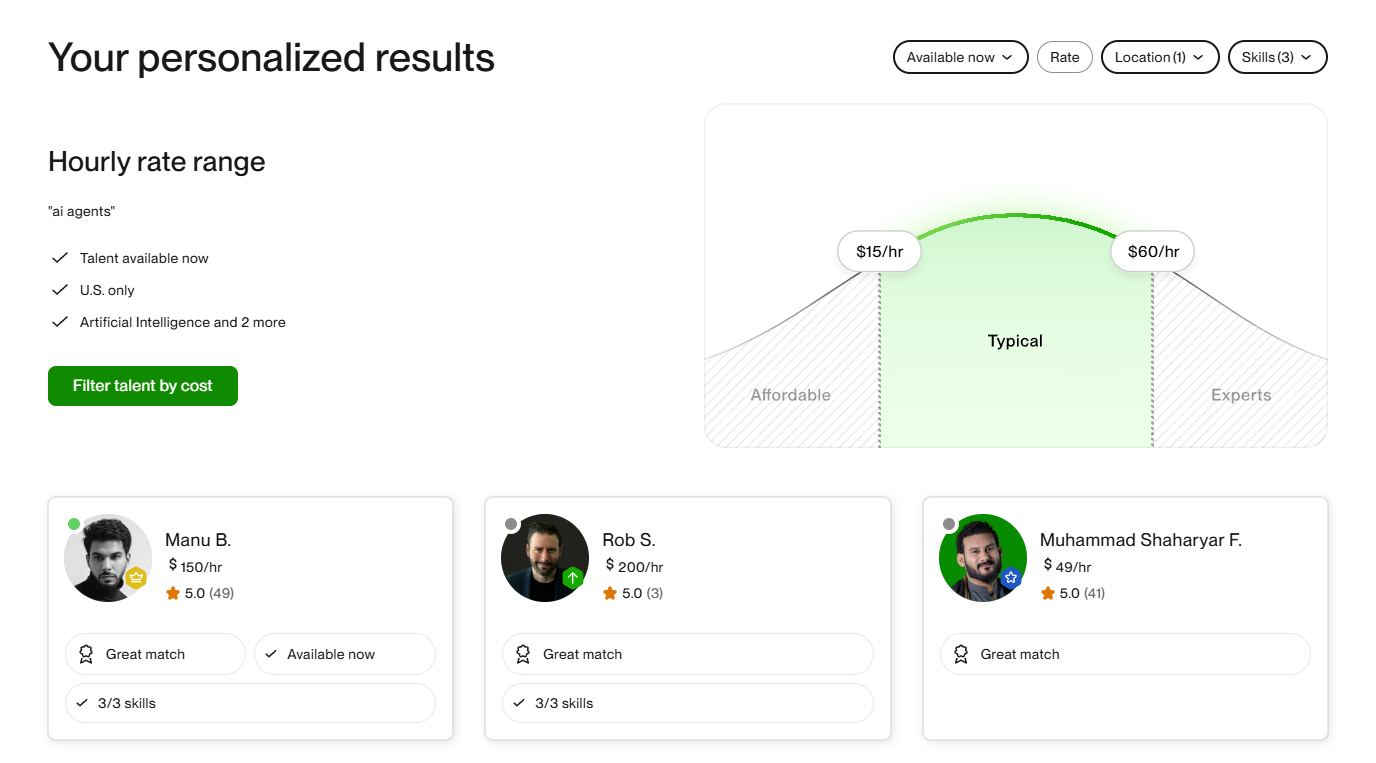
I searched “AI agents” directly on Upwork, and the platform’s own data showed a typical hourly rate range of $15 to $60 an hour for that search. But that “typical” range honestly doesn’t tell the whole story. Looking at actual freelancer profiles that came up as strong matches, the spread was way wider than that typical range suggests, one freelancer was listed at $150/hour with a 5.0 rating across 49 reviews, another at $200/hour with a smaller but perfect 3-review track record, and a third at $49/hour with 41 reviews. That’s not a small range, it’s basically the difference between a beginner rate and a senior specialist rate, all under the same search term.
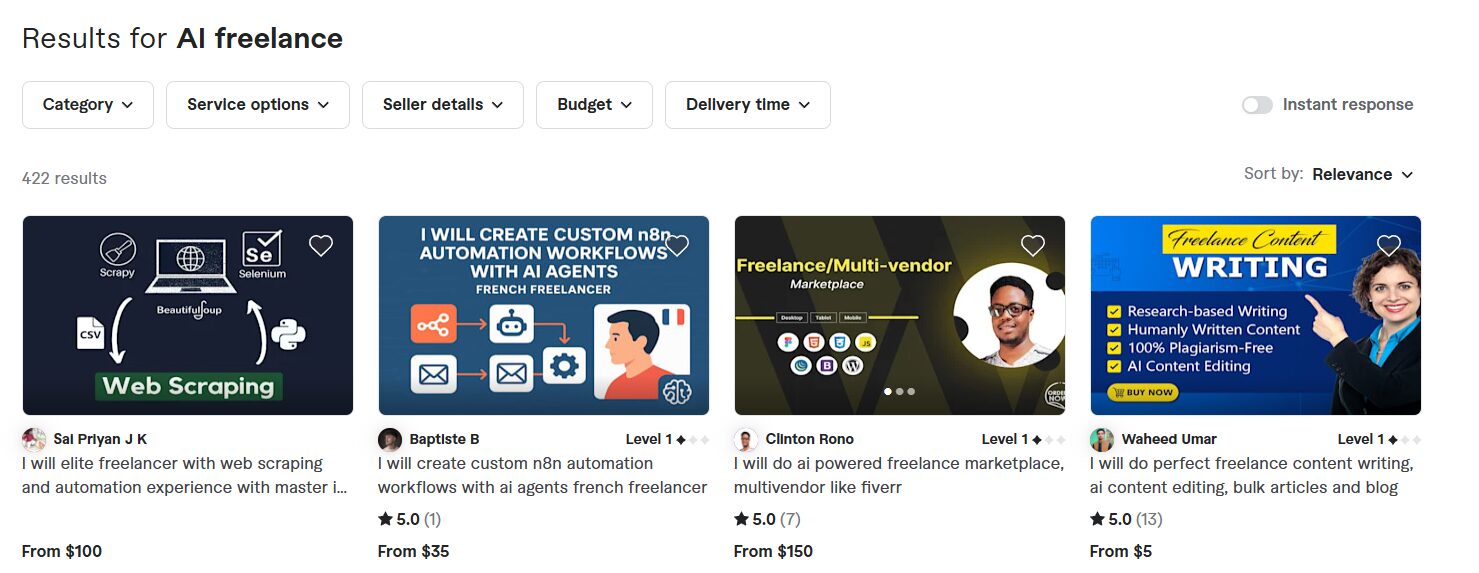
Fiverr tells a different story. Searching “AI freelance” brings up just 422 results, with a menu-like pricing structure:
$5 for basic AI writing
$35 for custom n8n automation workflows
$150+ for building full AI-powered marketplaces
Interestingly, many of the technical automation and agent gigs are held by Level 1 sellers with only a few reviews. This means the niche is still early enough that you don’t need years of platform history to charge solid rates for real technical work.
So what’s the honest takeaway from actually looking at this instead of just reading someone’s income claim? Rates for AI agent work genuinely do range from around $15/hour on the low end to $200+/hour for specialists, that part of the hype is real. But most people searching either platform right now are landing somewhere in the middle, not the flashy top end, and definitely not the bottom “content writing” gigs that get lumped into the same search results. Where you land really comes down to whether you’re offering generic AI-assisted work or a specific, technical AI agent build, same distinction we covered in the last section.
If you’re weighing which AI model to actually build these agents with, since that choice affects both your build speed and your margins, our GPT-5.6 vs Grok 4.5 vs Claude comparison breaks down real pricing and benchmark differences between the three most-used options right now.
The Realistic Earnings Timeline (Month 1 vs. Month 6 vs. Year 1)
Here’s where most of the hype falls apart, timeline. Income screenshots almost never show you the months of unglamorous work that came before the big number, so here’s what a realistic timeline actually looks like based on reported data from people who’ve actually done this.
Months 1-2, the Learning Phase. Most people earn somewhere between $100 and $500 during this stretch. This is when you’re building your profile, taking on your first small projects, and getting your first reviews. It’s genuinely slow, and honestly it’s supposed to be, you’re building the foundation everything else depends on.
Months 3-6, Momentum Starts. With a clear niche and consistent outreach, freelancers in this stage typically reach $1,000 to $3,000 a month. This is usually when the work starts feeling less like scrambling for any gig and more like a real, repeatable process, you actually know what to pitch, who to pitch it to, and roughly what to charge.
Beyond 6 Months, Specialization Pays Off. Freelancers who’ve picked a specific niche (real estate lead qualification, e-commerce inventory automation, customer service escalation, whatever it is) and started moving clients toward retainer relationships instead of one-off projects routinely reach $3,000 to $10,000+ a month. Some specialists with strong documented case studies push well past that, but that’s the exception, not where you start.
The pattern across every stage is basically the same, the people who reach the higher numbers aren’t the ones who found some secret trick. They’re the ones who picked one clear niche, stuck with it past the slow first couple of months, and moved from charging by the hour to charging retainer clients for ongoing value. That’s not a hack, it’s just how service businesses tend to work, AI or not.
If there’s one honest correction to make to the hype version, nobody skips the first stage. Even the freelancers now charging $150-300/hour spent months 1 and 2 in that same slow $100-500 range everyone else starts in.
The Honest 30-Day Test Nobody’s Talking About
Most of what circulates online about AI agent income comes from people selling something, a course, a template, a “done for you” system. So it’s worth paying extra attention when someone runs a real test with nothing to sell.
A developer on DEV Community did exactly that, spent 30 days actually running an AI agent to see if it could generate real income, and published the results without dressing it up as a success story. The honest framing he landed on is genuinely useful, the “passive income” from an AI agent isn’t really passive income at all, it’s more of a time dividend. The agent hands you back hours. What actually happens to your income depends entirely on what you do with those hours.
Over the 30 days, he reported saving roughly 30-40 hours of work. But he was also upfront that the agent didn’t run itself flawlessly the whole time, about a dozen times over the month, something broke silently, a scraper hit a page that had changed, an alert misfired, a file didn’t save correctly. None of it was catastrophic, but every single time, it needed him to actually notice the problem and fix it. True hands-off operation, even a month in, still needed regular supervision.
He also tested whether the agent could handle something higher-stakes, automated trading, and deliberately chose not to let it execute trades on its own after reviewing its reasoning and finding enough shaky judgment calls that he was glad he hadn’t flipped that switch. That’s a genuinely useful data point, even someone building agents professionally didn’t trust one to run financial decisions unsupervised after 30 days of testing.
The bottom line from someone who actually ran the experiment instead of just claiming success, an AI agent will make you more productive if you’re already doing income-generating work and want to do it faster. It won’t hand you income out of nothing while you’re not paying attention. That’s exactly the gap between the hype version and the real version this whole article’s trying to close.
You can read his full breakdown here: Can an AI Agent Really Generate Passive Income? My Honest 30-Day Test
If you want to see this same “am I actually building something real or falling for the hype” question applied to a completely different corner of AI right now, our web story on the AI squish trend walks through the same kind of hands-on, no-hype testing, just for a much sillier use case.
Red Flags: How to Spot the Hype Version
Once you know what real AI agent freelancing looks like, the hype version gets a lot easier to spot. Here are the patterns worth walking away from immediately.
Anything that requires payment before you can earn. This is honestly the single clearest signal. Real AI income paths, freelancing, consulting, building actual client work, cost you time, not an upfront fee for access to a “system.” If someone’s selling you the system before you’ve made a dollar, that’s the business model, not a shortcut to yours.
Guaranteed income promises. No legitimate freelancer, AI or not, can guarantee you’ll earn a specific amount. Client work depends on your skill, your outreach, your niche, and honestly some luck and timing. Anyone promising a guaranteed number is selling certainty they can’t actually back up.
Income screenshots without method details. A screenshot of a bank balance or a dashboard tells you nothing about how that money was made, how long it took, or what came before it. If a claim isn’t paired with real specifics (what service, what platform, what niche, what timeline), just treat it as marketing, not evidence.
“Secret” prompts or systems locked behind a paywall. The actual skills involved in AI agent freelancing, understanding client workflows, connecting tools like Zapier or Make, prompting AI models effectively, aren’t secret at all. They’re learnable, and honestly most of the genuinely useful info about how to do this is available for free if you’re willing to look for it.
Faceless-channel templates promising passive scaling. Be especially skeptical of anything framing this as a way to build a hands-off, scalable business fast. Like the honest 30-day test above showed, even a working agent needs regular human attention to catch things that break. Anyone selling “set it and forget it” income is skipping the maintenance reality on purpose.
The clearest filter, honestly, is pretty simple, real AI income comes from doing real work with AI as the accelerant, not from buying access to someone else’s “proprietary” system. If an offer flips that order, payment first, results later, walk away.
So, Is It Actually Worth It?
Yeah, but only if you go in with realistic expectations. Score: 4/5
It’s worth it if you already have a skill AI can speed up, writing, design, marketing, automation logic, and you’re willing to treat this like an actual business, pitching consistently, building a portfolio, and sticking with it for 3-6 months before judging results. The rate data’s real. The demand’s real. People genuinely are earning $1,000 to $10,000+ a month doing this.
It’s not worth it if you’re looking for passive income with zero effort, or you’re hoping an agent just does the work while you sleep. That version doesn’t exist yet, even the most honest firsthand accounts confirm you still have to notice problems, fix broken workflows, and put in real hours. Come for the acceleration, not the magic.
FAQ
1. Is AI agent freelancing actually worth it in 2026? Yeah, for the right person. Real rates run from $15 to $200+ an hour depending on skill level and niche, but it takes 3 to 6 months of consistent effort to actually build momentum, not the overnight income some marketing claims suggest.
2. How much can you realistically make freelancing with AI agents? Real data from platforms like Upwork shows a typical range of $15 to $60 an hour for general AI agent work, with specialists charging $150 to $300+ an hour. Most beginners land somewhere in the $500 to $3,000 a month range in their first few months, not the “$10k/month” figures you see thrown around in marketing.
3. Do you need to know how to code to freelance with AI agents? Not really. Plenty of AI agent freelancers use no-code and low-code tools like Zapier, Make, and n8n to build working automations without writing a single line of traditional code. That said, some coding knowledge does open the door to higher-paying, more technical projects.
4. How long does it take to start making money with AI agents? Most people earn very little at first, often just $100 to $500, in the first one to two months while building a profile and getting initial reviews. Consistent freelancers typically hit $1,000 to $3,000 a month by months three to six, with specialists earning more after that.
5. What are the biggest red flags in AI agent freelancing courses? Watch out for anything requiring upfront payment before you can start earning, that’s almost always a scam. Other warning signs include guaranteed income promises, income screenshots with zero explanation of the actual method, and “secret” prompts or systems locked behind a paywall.
- Claude Sonnet 5 for Developers Review: Security & Coding Breakdown, if you’re building agents with Claude, here’s where it actually holds up.
- GPT 5.6 vs Grok 4.5 vs Claude: Which Is Better?, real pricing and benchmark data to help you pick a model before you start building client work.
Related Web Stories:
2 thoughts on “Is AI Agent Freelancing Actually Worth It? Honest Take”