
Does EU AI Act Affect US Businesses? August 2026 Deadline Explained
Quick Answer: Yes, the EU AI Act can affect US businesses, even if you have zero EU offices or employees. If any EU user can access your AI tool’s output, you’re potentially in scope. But here’s what most coverage gets wrong: the big “high-risk” obligations everyone was panicking about got delayed to December 2027. What actually hits August 2, 2026 is narrower: Article 50 transparency rules and enforcement powers for General Purpose AI models. For most small US businesses, the practical impact is limited but not zero.
So you’ve probably seen the headlines. “EU AI Act deadline hits August 2.” “US businesses could face fines.” “Are you compliant?” And then you go look for a clear answer on whether any of this actually affects you, and instead you find a 47-page law firm PDF written for Fortune 500 legal teams, or a breathless tech blog that treats every US business like it’s running a facial recognition system for loan applications.
Here’s what’s actually going on, explained the way a friend who read all the legalese would explain it to you.
The EU AI Act is real. The August 2, 2026 deadline is real. But the way it’s being reported is genuinely confusing, because two completely separate sets of obligations have gotten mixed together in most coverage. One set was significantly delayed in May 2026 (the high-risk stuff most people were worried about). A different set hits August 2 regardless (the transparency and disclosure rules). Most articles cover only one of those two stories, and which one they cover determines whether their headline sounds terrifying or totally fine.
Whether the EU AI Act affects your US business depends on what you’re building, who your users are, and how you’re using AI. Let’s actually answer that.
What the EU AI Act Actually Is (And Why It Can Reach US Businesses)
The EU AI Act became law in August 2024 and runs on a phased rollout. It classifies AI systems into four risk tiers, and the obligations get heavier as you move up the pyramid.
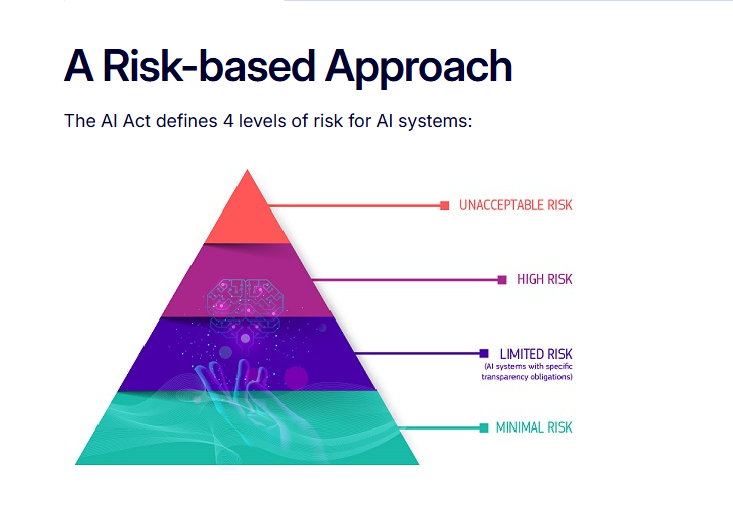
That pyramid from the official EU AI Act materials shows how the regulation thinks about AI. The vast majority of AI systems, basic chatbots, spam filters, recommendation engines for non-sensitive products, fall into Minimal Risk. No obligations. Limited Risk systems (the third tier, which includes things like AI chatbots that interact with people) have specific transparency obligations, including the Article 50 rules hitting August 2. High Risk systems (hiring tools, credit scoring, medical devices with AI components, biometric identification) had the most demanding obligations, and those got pushed to December 2027. Unacceptable Risk practices are already banned.
The thing that surprises most US businesses is the jurisdiction question. The EU AI Act doesn’t care where your company is headquartered. It cares where your AI system’s output lands. Under Article 2, the Act applies to providers placing AI systems on the EU market, and to providers or deployers located outside the EU when an AI system’s output is used in the EU. If an EU user can call your API, use your chatbot, or receive AI-generated content from your platform, you’re potentially in scope, even if every single employee, server, and office is in the United States.
The EU AI Act follows the same playbook as GDPR. If you lived through the GDPR compliance scramble in 2018, you know exactly how this movie goes. The extraterritorial reach is real, the enforcement starts with big players, and eventually the obligations trickle down to smaller businesses too.
The Two-Clock Problem: What August 2 Actually Hits
Here’s the part where most US business owners get confused, and honestly, most of the coverage isn’t helping.
The EU AI Act has two separate deadlines that got conflated. EWSolutions, an enterprise AI compliance firm, put it plainly in their July 2026 analysis:
💬 Expert quote, verified: “The EU AI Act now runs on two clocks, and US companies keep reading the wrong one… Confuse them, and you optimize for the deadline you don’t have while missing the one you do.”
Source: 👉 https://www.ewsolutions.com/eu-ai-act-updates-2026/
Clock One covers high-risk AI systems under Annex III: hiring algorithms, credit scoring tools, educational access systems, biometric identification, critical infrastructure. On May 7, 2026, the EU Parliament agreed on a Digital Omnibus that pushed these obligations from August 2, 2026 to December 2, 2027. That’s the delay everyone celebrated. If you were worried about your HR software or loan decisioning tool, that worry now has 16 more months of runway.
Clock Two covers General Purpose AI (GPAI) model providers and the Article 50 transparency obligations. Those were NOT delayed. They hit August 2, 2026, as originally scheduled. Article 50 requires that AI systems which generate synthetic audio, image, video, or text content be marked in machine-readable format detectable as artificially generated. Chatbots must identify themselves as AI when a user sincerely wants to know if they’re talking to a human or a machine. These rules apply to providers (companies building AI tools) and deployers (businesses using AI tools commercially).
The asymmetry is the whole story here. The deadline that moved is the one most typical US SaaS businesses weren’t going to trip first anyway. The deadline that held is the one that directly touches AI content creation, chatbots, and any business using AI-generated content for commercial purposes with EU customers.
For most US businesses with any EU exposure, the practical August 2 question is: are you disclosing when your chatbot is an AI, and are your AI-generated images/videos carrying metadata that identifies them as synthetic?
How the EU AI Act Fines Actually Work
Let’s talk about the fines, because the numbers are scary enough to make anyone pay attention, but the way they work is more nuanced than headlines suggest.
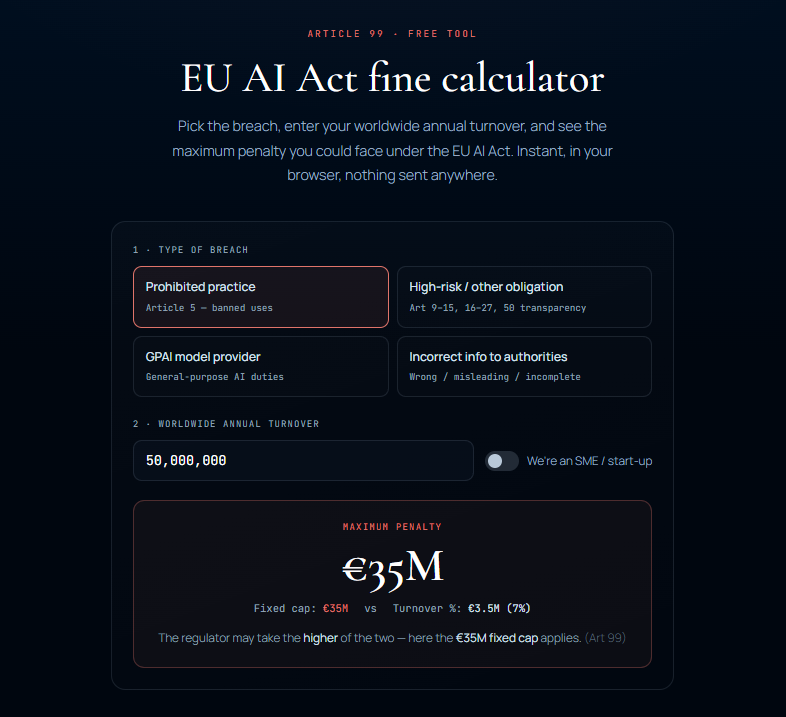
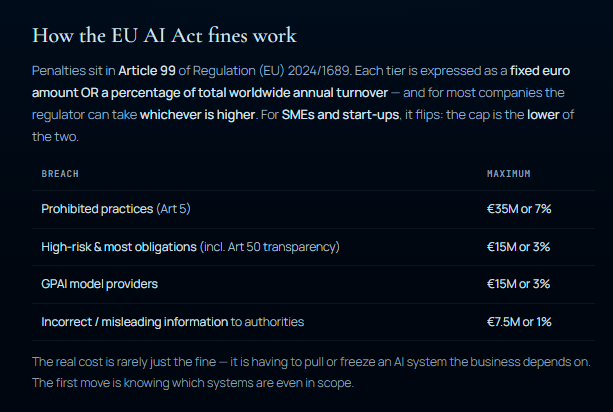
The fine structure from the official Article 99 breakdown:
Prohibited practices (the banned stuff at the top of the pyramid, like social scoring by governments or real-time biometric surveillance in public spaces): up to €35 million or 7% of worldwide annual turnover, whichever is higher.
High-risk obligations and most other violations including Article 50 transparency: up to €15 million or 3% of worldwide annual turnover, whichever is higher.
GPAI model providers: up to €15 million or 3% of worldwide annual turnover, whichever is higher.
Incorrect or misleading information given to authorities: up to €7.5 million or 1% of worldwide annual turnover, whichever is higher.
Two things that fine calculator screenshot illustrates clearly: first, for a $50M revenue company, the fixed cap of €35M beats the 7% turnover calculation, so the fixed cap applies. Second, there’s an important flip for SMEs and startups: for smaller companies, the fine is the lower of the fixed amount and the percentage, not the higher. A startup with $1M in revenue facing a prohibited practices violation would face €70,000 (7% of $1M), not €35M. That’s still serious, but it’s not company-ending.
The fine calculator shown here is from Article 99, a free tool available online. Worth running your own numbers through it before assuming either the best case or worst case.
One more thing the fine table notes that’s worth repeating: “The real cost is rarely just the fine. It is having to pull or freeze an AI system the business depends on.” That operational risk, losing the tool rather than just paying the fine, is often more damaging than the financial penalty for smaller businesses that have built workflows around AI.
For context on what happened when a government actually forced an AI company to freeze access to a model with no warning, our Claude Fable 5 shutdown explainer covers the first documented case of a government-ordered AI model pulldown, which is exactly the operational risk the fine table is warning about.
Does the EU AI Act Affect US Businesses? Here’s the Honest Answer by Business Type
Let me break this down by who you actually are, because the answer is genuinely different depending on your situation.
You’re a US-only solopreneur or small business with no EU customers: Honestly, the EU AI Act probably doesn’t affect you right now. Article 50 targets providers and deployers in commercial contexts with EU users. If your customers are all US-based and your AI tools don’t produce content that reaches EU users, your exposure is minimal to none. Personal use of AI tools is also explicitly exempt. You can keep using ChatGPT, Claude, and Canva for your own work without any compliance concern.
You’re a US SaaS company with EU users: This is where August 2 matters. If you use AI chatbots that interact with EU users, you need to ensure users can tell they’re talking to AI when they sincerely ask. If you use AI to generate images, video, or audio content delivered to EU users, those outputs may need to carry C2PA metadata marking them as AI-generated. The practical gap here is worth knowing: social platforms like Instagram, X, and YouTube currently strip C2PA metadata during upload processing, so the technical obligation and the practical reality aren’t fully aligned yet.
You’re building an AI product or API serving EU markets: You’re a GPAI provider if your model is used by other businesses. GPAI obligations have been in effect since August 2025. Article 50 transparency obligations hit August 2, 2026. You need technical documentation, EU disclosure of training data summaries, and mechanisms to support downstream deployers with compliance information.
You use AI for hiring, credit decisioning, or other high-stakes decisions with EU employees or customers: The Annex III high-risk obligations were pushed to December 2027 by the Digital Omnibus. You have 16 more months. Use them, because the compliance requirements for high-risk systems are substantial.
Our does Claude Cowork actually replace ChatGPT Enterprise piece is relevant here if you’re also evaluating which enterprise AI tools to build workflows around as the regulatory landscape solidifies.
What to Actually Do Before August 2
If you have any EU exposure, here’s the practical short list:
First, know which risk tier your AI systems fall into. The risk pyramid screenshot above is the official framework. If you’re doing anything in the Unacceptable Risk tier, stop (those practices have been banned since February 2025 anyway). If you’re in the Limited Risk tier, the main obligation is transparency and disclosure starting August 2.
Second, if your product or service uses a chatbot, make sure it identifies itself as AI when asked. This is the most concrete, actionable thing most US businesses with EU users need to do before August 2.
Third, if you’re generating AI images, video, or audio for commercial use with EU customers, check whether your AI tool vendor is embedding C2PA metadata. Adobe Firefly, OpenAI’s image tools, and Microsoft are implementing this. The obligation falls on providers to embed it, and on deployers to not deliberately strip it.
Fourth, review your terms of service. If your product uses AI to make decisions that could affect users’ access to services or employment, get legal review even with the Annex III delay, because the 2027 deadline comes up faster than you think.
For anyone also navigating AI tool decisions for their team right now, our best free AI image generator July 2026 tier list covers which image tools are already implementing C2PA metadata (relevant for EU AI Act Article 50 compliance).
Does the EU AI Act Affect US Businesses? Verdict
For most small US businesses that only serve US customers, no, the EU AI Act doesn’t really affect you right now. The obligations are real, but the extraterritorial reach requires your AI output to actually reach EU users.
For US businesses with any EU user base, whether that’s EU customers, EU employees, or a product accessible in EU countries, August 2 is real. The Article 50 transparency obligations are narrow but enforceable. Fines for Article 50 violations go up to €15 million or 3% of worldwide turnover, and that’s the actual August 2 exposure, not the scarier headline numbers that apply to prohibited practices.
The big picture: the EU AI Act is the most significant AI regulation passed anywhere in the world so far, and it will shape global AI norms the same way GDPR shaped global data privacy norms. US businesses that figured out GDPR compliance early had a meaningful advantage when enforcement started. The same dynamic is playing out here. The high-risk obligations being pushed to 2027 doesn’t mean the law isn’t real or isn’t coming. It just means the most demanding parts of it have a longer runway.
If you have EU exposure, the time to start understanding your obligations is now, not when you get an enforcement notice.
- Why Did Claude Fable 5 Get Shut Down? — the first documented case of a government-ordered AI model pulldown, which illustrates exactly the operational risk the EU AI Act’s fine table warns about.
- Does Claude Cowork Actually Replace ChatGPT Enterprise? — useful for evaluating which enterprise AI tools to build workflows around as regulatory compliance becomes a vendor selection criterion.
- Best Free AI Image Generator July 2026: Tier List — covers which AI image tools are implementing C2PA metadata, relevant for Article 50 compliance.
- How to Make Money With AI Instead of Losing Your Job — the broader context of building AI workflows that are sustainable as regulations evolve.
Related Web Stories:
- Claude vs Grok 4.5 vs GPT-5.6: Who Wins?
- Why Claude Now Wants Your Government ID
- Meta Just Put AI Image Gen in Your Instagram
FAQ
1. Does the EU AI Act affect US businesses in August 2026? Yes, if your AI tool’s output reaches EU users. The EU AI Act applies based on where outputs land, not where your company is based. For August 2 specifically, the Article 50 transparency obligations are the main thing hitting US businesses with EU customers. The bigger high-risk obligations were delayed to December 2027.
2. What actually happens on August 2, 2026 under the EU AI Act? Article 50 transparency rules and enforcement powers become active. This means chatbots must identify themselves as AI when sincerely asked, and AI-generated images, video, and audio in commercial contexts must carry machine-readable metadata marking them as synthetic. The high-risk Annex III system obligations were pushed to December 2027 by the Digital Omnibus agreement in May 2026.
3. What are the EU AI Act fines for US companies? The maximum fine for prohibited practices is €35 million or 7% of worldwide annual turnover, whichever is higher for large companies. For Article 50 transparency violations, it’s €15 million or 3%. For smaller businesses and startups, the fine is the lower of the two figures rather than the higher, which significantly reduces the maximum exposure.
4. Do I need to worry about the EU AI Act if I have no EU customers? Probably not for August 2. The Act’s extraterritorial reach applies when your AI system’s output is used in the EU. If your users are all US-based and your AI tools don’t produce content reaching EU users, your exposure is minimal. Personal use of AI tools is also explicitly exempt from Article 50 obligations.
5. What is Article 50 of the EU AI Act and why does it matter for US businesses? Article 50 is the transparency provision that requires AI systems interacting with people to identify themselves as AI when asked, and AI-generated synthetic content to carry machine-readable metadata. It applies to both providers (companies building AI tools) and deployers (businesses using AI tools commercially with EU users). It becomes enforceable on August 2, 2026, regardless of the Digital Omnibus delay that pushed other obligations to 2027.