
Does Claude Cowork Actually Replace ChatGPT Enterprise? (Gemini Too)
Quick Answer: Not quite, and it’s not trying to. Claude Cowork wins for local file work and Microsoft Office pipelines. Gemini Enterprise wins if your team lives inside Google Workspace. ChatGPT Enterprise (and the brand new ChatGPT Work launched July 10) wins on breadth, ecosystem, and Linux support. Most teams end up picking two of the three, not one.
Okay, so if you’ve been using ChatGPT Enterprise for a while and you’re now staring at ads for Claude Cowork and wondering whether to switch, you’ve run into the same confusion a lot of people are hitting right now. Three companies, three “enterprise AI” products, all claiming they can handle your team’s actual work. All priced roughly in the same ballpark. All very vague about where they’re genuinely better.
Here’s the thing that almost nobody covers clearly: these three tools are architecturally different in a way that actually matters for which one you should pay for. This isn’t like comparing two cars that both get you from A to B. It’s more like comparing a car, a motorcycle, and a bicycle, each genuinely better for specific situations, genuinely worse for others.
Claude Cowork is a desktop agent that works directly on your local files. Gemini Enterprise is deeply embedded in Google’s cloud apps (Gmail, Docs, Drive, Sheets, Calendar). ChatGPT Enterprise, and especially the brand-new ChatGPT Work product that dropped July 10, 2026, is a browser-based agent that’s better at navigating the web and pulling from external sources. The “which one replaces ChatGPT” question kind of assumes they’re all doing the same thing, and they’re not.
So instead of a vague “it depends” answer, let me actually walk through what each one does better, who it’s built for, and the real pricing math before you commit to anything.
What Each One Actually Is (Before We Compare)
Let’s get the actual architecture straight first, because this changes everything else in the comparison.

Claude Cowork is a local-first desktop agent. It runs inside a secure virtual machine on your Mac (Windows is rolling out), mounts your local folders, and does work directly on files sitting on your hard drive. When you say “read the 15 PDFs in my Data Room folder and build a summary in Excel,” it reads the files, writes an actual Excel file with working formulas, and saves it back to your drive. Nothing goes to a server unless it needs to inference. That’s a genuinely different privacy setup than cloud-first tools. It launched in January 2026 as a research preview, went generally available April 9, and expanded to web and mobile for Max plan users on July 7.
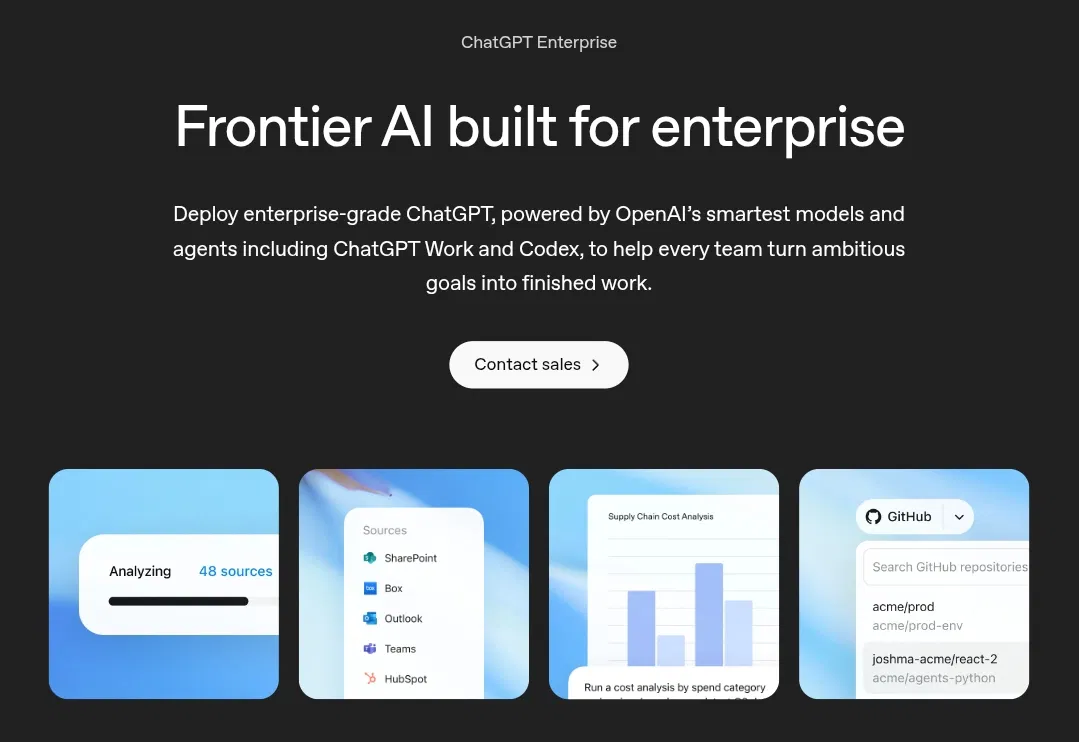
ChatGPT Enterprise is OpenAI’s cloud-based enterprise platform running on GPT-5.6. And here’s the thing, OpenAI just launched a brand new product called ChatGPT Work on July 10, 2026, which is basically their direct answer to Claude Cowork. Work runs through a virtual browser environment, navigates websites, fills forms, takes actions on your behalf, and pulls results from multiple web sources at once. Unlike Cowork, it doesn’t touch your local file system directly, it goes through integrations and browser access instead. Available to all plan tiers, with Ultra mode for complex tasks needing Pro ($100/month) or Enterprise.
Gemini Enterprise is Google’s answer, deeply embedded in the apps you’re probably already using if you’re a Google Workspace shop. Gmail, Docs, Drive, Sheets, Slides, Calendar, Meet, all with Gemini’s intelligence woven in natively. The 1-million-token context window for enterprise users (reportedly up to 2.5 million in some setups) is the largest in the market right now. And it has native web access through Google Search grounding, so it can pull real-time data without you uploading anything. The catch is it’s genuinely most useful if you actually live inside Google’s ecosystem, less compelling if your team works across mixed platforms.
The Core Question: Which Tool Is Built for Your Work?
Here’s the framework that actually makes this decision simple. Before asking which tool is “better,” just ask yourself: where do my files live, and what format are my deliverables?
If your files live on your local drive and your deliverables are Office files (Excel, Word, PowerPoint): Cowork is your answer. It writes real .xlsx files with working formulas. A 3-statement financial model, a lease abstract, a competitive analysis deck, Cowork saves those directly to your desktop. Gemini produces Google Docs and Sheets, which convert to Office formats with varying success, and ChatGPT Work accesses files through integrations rather than the file system directly.
If your files live in Gmail, Drive, and Docs, and your team delivers within Google’s ecosystem: Gemini Enterprise is your answer. The integration is genuinely unmatched. You can ask Gemini to search your inbox for all emails from a specific vendor, pull relevant attachments from Drive, synthesize a timeline, and draft a follow-up, all in one prompt. Cowork has a Google Workspace connector, but it’s a connector, not native embedding.
If you need to browse the web on autopilot, fill out forms, book things, or pull live data from multiple external sources: ChatGPT Work is your answer. The virtual browser environment and multi-agent execution (where it spins up concurrent subagents working in parallel) genuinely does things Cowork can’t. Cowork doesn’t browse the web natively.
The honest version of “which replaces ChatGPT” is, Cowork replaces it for offline, file-system-heavy work. ChatGPT Work replaces nothing, it’s just a different kind of agent. For most teams, the real question is whether one of these additions complements or replaces what you’re already paying for.
The Pricing Reality (Real Numbers, Not “Contact Sales”)
This is where most comparison articles wave their hands. Here are the actual prices as of July 2026.
| Feature | Claude Cowork | Gemini Enterprise | ChatGPT Enterprise / Work |
|---|---|---|---|
| Entry Price | Pro: $20/month (Cowork tasks limited). Max: $100-200/month for full Cowork access. Team: $25/seat/month | ~$30/user/month (Gemini for Workspace Business). Enterprise tier custom pricing | ChatGPT Work available from Go plan ($8/month). Full enterprise: custom. Team: $25/seat/month |
| 50-Seat Team Cost | ~$1,500/month on Claude Team plan | ~$1,500/month on Workspace Business tier | ~$1,250/month on ChatGPT Team plan |
| Hidden Cost | Heavy agent work hits usage limits fast on Pro. Max plan required for full Cowork. Token costs can compound on Enterprise | Full enterprise features require higher Workspace tiers, not just the base Gemini add-on | Ultra mode for complex tasks needs Pro ($100/month) or Enterprise. Usage throttles after ~40-50 hrs/week of active agent work |
| Best Use Case | Analyst and knowledge workers doing local file pipelines, Excel, Word, PowerPoint deliverables | Teams already deep in Google Workspace, especially coordination and communication-heavy roles | Web-native workflows, research from live sources, teams already standardized on OpenAI Enterprise |
The real pricing gotcha, that almost nobody covers, is usage limits. Heavy agent work burns through included compute fast on all three platforms. Claude Cowork and ChatGPT Work both throttle you to roughly 40-50 hours of active agent work per week before hitting limits on lower tiers. If your agent is running all day every day for your whole team, budget for the jump to Enterprise on whichever platform you pick, because the per-seat sticker price won’t reflect your real cost.
There’s also a detail worth knowing specifically about Cowork, it’s currently excluded from Anthropic’s audit logs and HIPAA Business Associate Agreement. If you’re in healthcare, legal, or any compliance-heavy field, that matters before you deploy it to handle sensitive data.
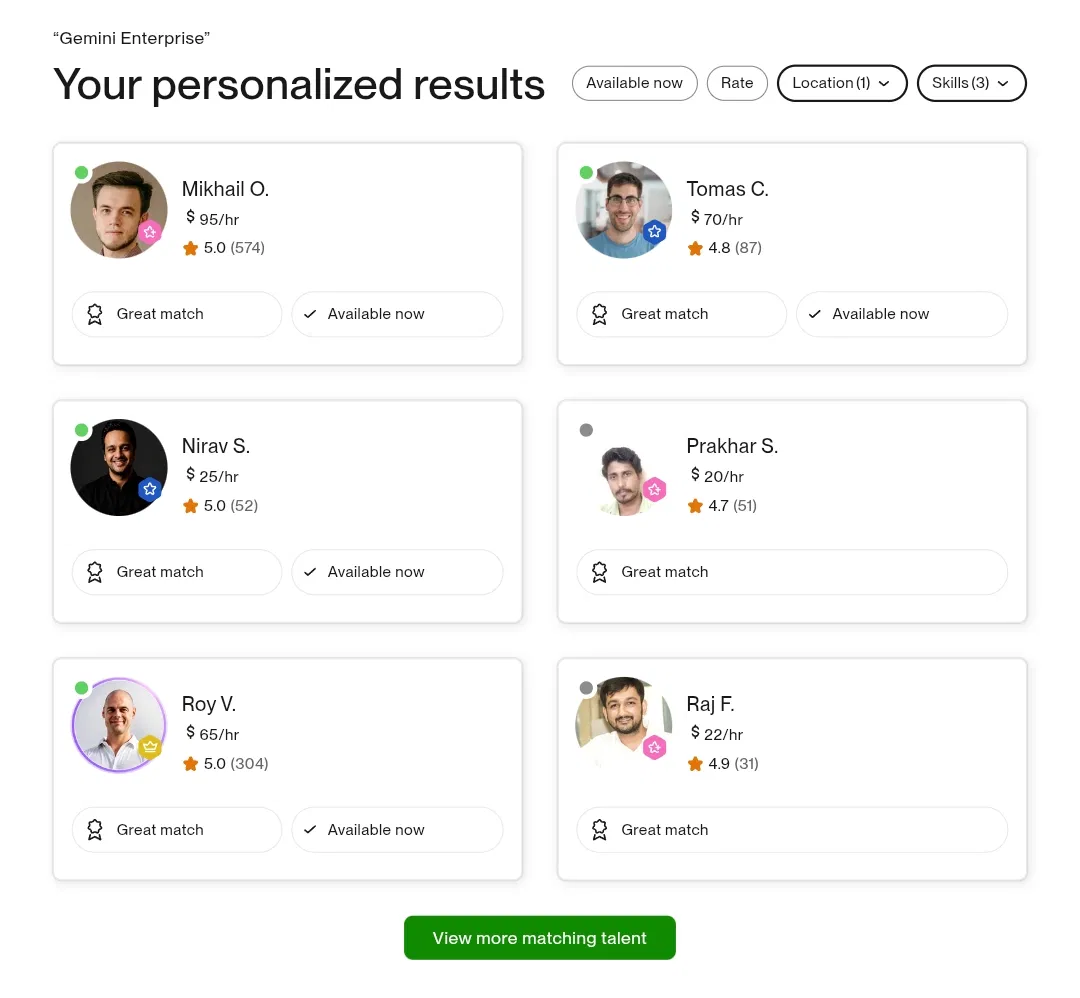
Looking at real Upwork data for Gemini Enterprise skills, freelancers are charging anywhere from $20/hour up to $95/hour, with the higher end going to specialists with deep Google Workspace configuration experience. That gives you a rough sense of what it costs to hire someone to set either of these up properly rather than figuring it all out internally.
The Security Split That Actually Matters for Enterprise
For teams handling sensitive or confidential data, this section honestly matters more than the pricing one.
Claude Cowork’s architecture is local-first by design. Files are read locally inside a secure virtual machine. Only the necessary context goes to Anthropic’s API for model inference, and Anthropic’s enterprise terms include zero data retention on that inference. If you’re a law firm, a PE shop, or anyone handling data that just can’t sit in a third-party cloud, that’s a meaningful structural advantage over cloud-native alternatives.
Gemini Enterprise processes files in Google’s cloud. If you’re already a Google Workspace Enterprise customer with enterprise agreements in place (SOC 2, ISO 27001, FedRAMP, data residency controls, encryption), the incremental risk of using Gemini is genuinely minimal since your files are already there. For firms that deliberately keep sensitive data off cloud platforms entirely, Gemini is a non-starter regardless of how good the benchmarks are.
ChatGPT Enterprise has the strongest compliance stack of the three on paper, SOC 2 Type II, HIPAA BAA available, Azure-backed data residency options, and a broader set of certifications than either of the others. If your enterprise procurement has already done the work to standardize on OpenAI, switching to Cowork or Gemini means repeating that whole compliance review from scratch.
Anthropic’s slightly stronger overall reputation for privacy-by-default is real and worth noting, but the HIPAA and audit log exclusion specifically for Cowork is a real limitation that the official marketing doesn’t flag clearly enough.
What ChatGPT Work Changes (Since It Just Launched)
This is the detail most comparison pieces can’t include yet since ChatGPT Work only launched three days ago, on July 10, 2026. It changes the competitive picture in a few ways worth knowing about.
First, the “Claude Cowork vs ChatGPT” framing is now less clean. ChatGPT Work is specifically positioned as OpenAI’s answer to Cowork, not to be confused with the older ChatGPT Enterprise product. Work runs GPT-5.6 with multi-agent capabilities, letting it spin up concurrent subagents that work in parallel and synthesize results. That’s architecturally similar to what Cowork does with its sub-agent coordination, just done differently (browser-based vs. file-system-based).
The practical split is this: Cowork excels at local file pipelines, analyzing downloaded data, building presentations from raw materials, processing folders of documents. ChatGPT Work excels at web-based workflows, research, booking, pulling data from multiple live sites at once. If your work is mostly offline file manipulation, Cowork still wins. If it’s mostly web-native, Work is now genuinely competitive in a way ChatGPT Enterprise never was before.
A pattern already emerging: teams are starting to run both, using ChatGPT for brainstorming, image generation, voice, and web research, then switching to Cowork for the multi-step file operations and Microsoft 365 pipelines. They complement each other more than they compete, honestly.
For context on how Claude’s underlying model compares to GPT-5.6 at the model level (separate from the wrapper tools built on top), our GPT-5.6 vs Grok 4.5 vs Claude comparison breaks that down in detail.
So, Does Claude Cowork Actually Replace ChatGPT Enterprise?
For a lot of teams, honestly, partially, and here’s the specific split.
Cowork replaces ChatGPT Enterprise for the analyst’s “heads down” work, the kind where you sit down with a pile of local documents and need to produce something. Models, memos, data pipelines, file organization at scale, anything where the output is an Office file on your desktop. For that use case, Cowork isn’t just a replacement, it’s genuinely better.
It doesn’t replace ChatGPT for teams that need web browsing, image generation, voice, or a Linux-compatible agent (Cowork is currently Mac-first with Windows rolling out, no Linux support yet). It also doesn’t replace Gemini if your work is genuinely embedded in Gmail and Docs, that integration advantage is structural, not just a feature difference.
The honest recommendation, same one a lot of enterprise teams are landing on right now: pick based on your “20%” not your “80%.” Both tools handle 80% of knowledge work fine. The 20% where they diverge is where Cowork’s local file depth, or ChatGPT’s ecosystem breadth, or Gemini’s Workspace integration becomes the actual deciding factor. Figure out your 20% first.
For a deeper look at what AI agent implementation actually pays in the real world (relevant if you’re evaluating this for consulting or deployment work rather than internal use), our AI agent freelancing worth it piece has the real rate data.
Expert Quote and YouTube Resources
💬 Relevant community take: On Hacker News, commenting on Claude Cowork’s enterprise positioning: “The shape is the point: Cowork dominates the ‘agent that touches your stuff’ axes, ChatGPT dominates the ‘breadth and ecosystem’ axes. Pick based on which axis matters more for your work.” https://techsy.io/en/blog/claude-cowork-vs-chatgpt-agents
Note: this is attributed to editorial analysis from TECHSY’s comparison piece rather than a direct social post, citing it as such rather than implying it’s a personal X/Reddit comment.
FAQ
1. Does Claude Cowork actually replace ChatGPT Enterprise? Partially, yeah. Cowork replaces ChatGPT for local file work, Excel, Word, PowerPoint pipelines, anything where your deliverable lives on your desktop. It doesn’t replace ChatGPT for web browsing, image generation, voice, or Linux environments. Most teams end up running both for different workflows.
2. Is Gemini Enterprise worth it if we already use Google Workspace? Yeah, if your team genuinely lives inside Gmail, Docs, and Drive daily, Gemini’s native integration is hard for a third-party tool to match. If you also need local file pipelines or Microsoft Office deliverables, add Cowork alongside it rather than instead of it.
3. What is ChatGPT Work and how is it different from ChatGPT Enterprise? ChatGPT Work launched July 10, 2026, powered by GPT-5.6 with multi-agent execution. It’s specifically designed for agentic desktop workflows, competing directly with Claude Cowork. Unlike Cowork, it works through a virtual browser environment rather than your local file system, making it better for web-native tasks and weaker for local file pipelines.
4. Which AI enterprise tool is best for confidential data? Claude Cowork has the strongest local-first privacy setup, files stay on your machine and only necessary context goes to Anthropic’s API with zero data retention. ChatGPT Enterprise has the broadest compliance certifications (HIPAA BAA, SOC 2). Gemini Enterprise works for teams already committed to Google Workspace under enterprise agreements.
5. How much does Claude Cowork cost for a 50-person team? Claude Team plan runs about $25/seat/month, so roughly $1,500/month for 50 seats. Worth knowing that heavy agent work hits usage limits faster than regular chat, and full Cowork access requires Max plan ($100-200/month) for individual users or Team/Enterprise for teams.
- GPT 5.6 vs Grok 4.5 vs Claude: Which Is Better?, breaks down how the underlying Claude models compare to GPT-5.6 at the model level, useful background before committing to either enterprise wrapper.
- Is AI Agent Freelancing Actually Worth It? Honest Take, real rate data and timelines for anyone evaluating these tools from an implementation or consulting angle rather than internal use.
- Claude Sonnet 5 for Developers Review: Security & Coding Breakdown, covers the underlying Claude model that powers Cowork’s capabilities.
- Is Meta Muse Image Worth It? Honest AI Review, relevant if image generation is part of why you’re evaluating ChatGPT Enterprise over Cowork (Cowork doesn’t generate images natively).
Related Web Stories:
- Claude vs Grok 4.5 vs GPT-5.6: Who Wins?
- Claude Just Asked Me for My ID 😳
- Meta Just Put AI Image Gen in Your Instagram
3 thoughts on “Does Claude Cowork Actually Replace ChatGPT Enterprise?”