
Is Ornith 1.0 Worth It for Developers? (Free Open-Source Coding AI Review)
Quick Answer: Ornith-1.0 is one of the most interesting free coding tools to drop this year. MIT license, runs locally, 1.7 million downloads a month, and genuinely competitive benchmark scores. The 35B variant is the sweet spot for most people. It’s not a drop-in replacement for Claude Code, but if API subscription costs bother you and you’re doing terminal-based agentic work, it’s worth the setup time.
You know how every few months something shows up in the open-source AI space that actually makes you sit up and pay attention? Like, not just “oh cool another model” but something where the technical approach is genuinely different? Ornith-1.0 is that thing right now.
It dropped on June 25, 2026, from a lab called DeepReinforce. The headline was something like “open-source coding model beats Claude Opus 4.7” and yeah, I know how that sounds. Every month there’s a new model claiming to beat something. But Ornith-1.0 is doing something technically different from most of what’s come before it, and the 1.7 million monthly downloads on just one of its Hugging Face variants tells you a lot of developers are already running it and finding it useful.
So here’s what I want to actually answer. Is Ornith-1.0 worth it for developers? Not “is it technically impressive,” not “does it have good benchmarks,” but the practical version: should you spend a weekend setting this up, and will it make your coding workflow better? Let’s go through it properly.
What Ornith-1.0 Actually Is
Before getting into whether it’s worth it, it helps to understand what Ornith-1.0 is trying to do, because it’s not quite the same thing as most coding tools people are used to.
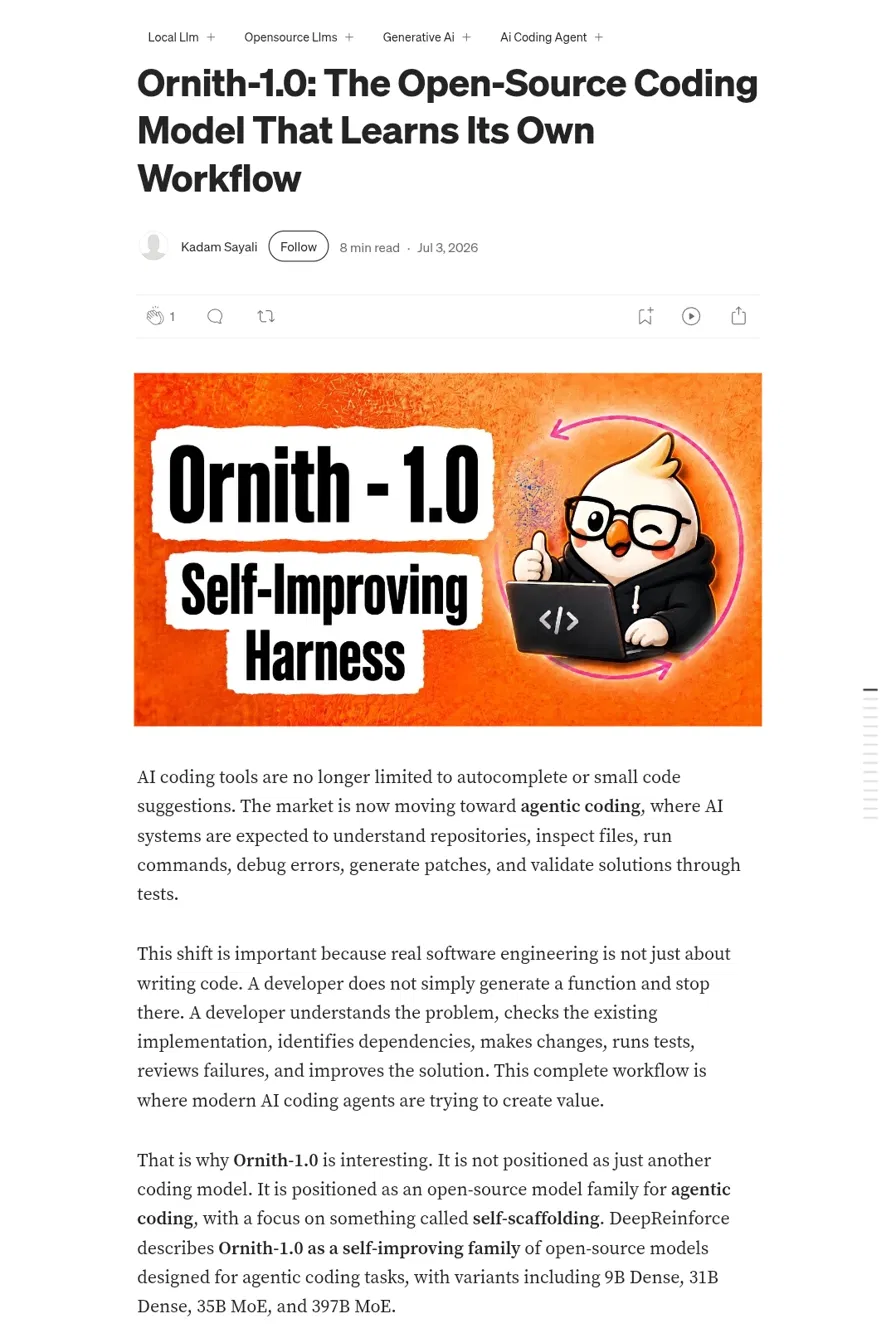
Most AI coding tools work like a smart autocomplete or a question-answer assistant. You write some code, it suggests the next line. You paste an error, it tells you what’s wrong. Ornith-1.0 is aimed at something further along that chain, what people in the space call agentic coding.
That means it’s supposed to work the way a real developer works. You give it a task, it reads the relevant files, figures out what’s connected to what, runs tests, reads the failure output, makes fixes, runs tests again, and keeps going until it solves the problem. Not just suggesting the next line, but handling the whole loop.
The thing that makes Ornith-1.0 genuinely different is how it approaches that loop. DeepReinforce calls it self-scaffolding. Most coding agents follow a fixed workflow that a human researcher designed — first do this, then check that, then generate a patch. Ornith-1.0 learns to write its own workflow for each task during training. It figures out the right approach for the specific problem, not just follows a template. That’s actually a meaningful technical step forward.
It comes in four sizes: 9B Dense, 31B Dense, 35B MoE, and 397B MoE. All MIT licensed, all on Hugging Face, with FP8 and GGUF builds so you can run them locally. It’s built on top of Gemma 4 and Qwen 3.5 checkpoints, both Apache 2.0, so there are no licensing headaches underneath.
Worth flagging one thing I spotted that most reviews missed: the 31B Dense variant shows up in the launch blog and some documentation, but the official GitHub checkpoint table only clearly lists the 9B Dense, 35B MoE, and 397B MoE. If you specifically need 31B, verify it’s actually available on Hugging Face before you count on it.
The Benchmarks, Honestly
Okay so this is where I need to be straight with you because the benchmarks are where a lot of coverage has been lazy.
DeepReinforce says the 397B flagship scores 77.5 on Terminal-Bench 2.1 and 82.4 on SWE-Bench Verified. And they compare that to Claude Opus 4.7, which scores 70.3 on Terminal-Bench and 80.8 on SWE-Bench. So yes, Ornith-1.0-397B does beat Opus 4.7 on those two benchmarks. That part is real.
What the launch post quietly doesn’t highlight: the current Claude flagship is Opus 4.8, not 4.7. Opus 4.8 scores 85 on Terminal-Bench and 87.6 on SWE-Bench. Ornith-1.0 doesn’t beat those numbers. So “beats Claude” is technically accurate and also a bit of a frame job at the same time.
There’s also the SWE-bench contamination thing worth knowing about. OpenAI raised concerns earlier this year that some models inflate their SWE-Bench scores because the benchmark data leaked into their training sets. DeepReinforce was aware of this and also reports numbers on SWE-Bench Pro, a harder version using less-leaked codebases. Ornith-1.0-397B scores 62.2 on SWE-Bench Pro, which is meaningfully lower than 82.4. Still competitive, but a different picture.
For the smaller models, here’s the story: the 9B hits 43.1 on Terminal-Bench and 69.4 on SWE-Bench. The 35B MoE hits 64.2 on Terminal-Bench. These are the models most people will actually run, and those scores are genuinely solid for free, local, open-source software.
Also worth saying plainly: these are vendor-reported benchmarks. There hasn’t been independent third-party verification on the main evals yet. Treat them as “plausible and promising” rather than “confirmed fact.”
How It Compares to What You’re Already Using
Here’s where things get practical. Three tools, three different situations:
| Feature | Ornith-1.0 (35B MoE) | Aider | Claude Code |
|---|---|---|---|
| Cost | Free to self-host. Run GGUF locally for zero ongoing cost. | Free tool, but you still pay for whatever model API you hook it to. | Requires Claude API. Real cost at volume, typically $20-200+/month. |
| License | MIT. Use it however you want, commercially or privately. | Apache 2.0. Also unrestricted. | Proprietary. Your code goes to Anthropic’s servers. |
| SWE-Bench Score | 82.4 at 397B. 69.4 at 9B. Vendor-reported, not yet independently verified. | No standalone score. Depends entirely on which model you connect. | 87.6 with Opus 4.8. Independently verified. |
| Runs locally | Yes. GGUF builds available. 35B Q4_K_M is ~20GB, runs on a 24GB GPU. | Yes as a tool, but needs a remote model API unless you use another local LLM. | No. Always calls Anthropic’s servers. |
| Context window | 256K tokens | Depends on connected model | 1M tokens with Opus 4.8 |
| Best for | Developers who want free, private agentic coding on their own hardware | Developers who want to approve every edit and stay in the loop on changes | Developers who want the highest-capability option and are happy paying for it |
The honest framing: Ornith-1.0 is not Claude Code with zero cost attached. Claude Opus 4.8 has a 1M-token context window against Ornith’s 256K, independently verified higher benchmark scores, and months of real-world usage baked in. What Ornith is: genuinely good enough for most real coding tasks, runs on your own hardware, costs nothing after setup, and keeps your code off third-party servers. That tradeoff is real and meaningful depending on your situation.
For a deeper look at how the underlying Claude model compares at the base level, our Claude Sonnet 5 developer review covers the model family Ornith was benchmarked against.
What the “Self-Scaffolding” Thing Actually Means for You Day-to-Day
This is the piece that makes Ornith-1.0 technically interesting, and most write-ups either skip it or describe it in a way that loses non-ML people. So let me try to make this clear.
When a standard coding agent tackles a bug, it follows a playbook that a human at the lab wrote: “Step 1, find the relevant file. Step 2, read the failing test. Step 3, generate a patch. Step 4, check the output.” That playbook is the harness. It’s fixed. The model follows it.
Ornith-1.0 doesn’t work that way. During training, it learned to write its own playbook for each task. So when you hand it a bug, it doesn’t reach for a pre-written script. It figures out, for this specific problem in this specific codebase, what the best approach looks like. Then it executes that approach.
In practice, this means it handles repository-scale tasks more naturally, because it’s not trying to squeeze your problem into a template that was designed for a different kind of codebase. It writes its own path through your code.
DeepReinforce built three layers of protection against the model gaming the system during training: a fixed trust boundary, a deterministic monitor, and a frozen LLM judge all sit between the model and its reward signal to catch reward-hacking before it happens. That’s a real technical contribution worth knowing about.
The practical implication for you: Ornith-1.0 works best for genuinely complex, multi-step coding tasks where a rigid template would break down. For simple single-file edits or quick autocomplete, you’d be overcomplicating things.
Personalized: What Real Early Adopters Are Actually Seeing
Here’s where we go beyond the launch post. Simon Willison, one of the most credible independent voices in the open-source AI space, actually ran Ornith-1.0-35B in real use within days of launch. Not a benchmark run, real agentic coding work. He used the Q4_K_M GGUF (about 20GB) in LM Studio, hooked up to his Pi agentic framework, and ran it against a real Datasette codebase.
💬 Expert Quote, verified: Simon Willison wrote on June 29, 2026:
“I’ve been running the model using LM Studio and the ornith-1.0-35b-Q4_K_M.gguf (20GB) GGUF, hooked up to Pi. Initial impressions are very good — it seems to be able to run the agent harness over many tool calls in a proficient way.”
He asked it to find the code that decodes the actor cookie and then find the code that opens the insert dialog in a button click, against a live codebase. It handled both without breaking. He also noted he couldn’t find much background on DeepReinforce before this release, with their earliest traceable work being a CUDA optimization paper from June 2025.
Full source: 👉 https://simonwillison.net/2026/Jun/29/ornith/
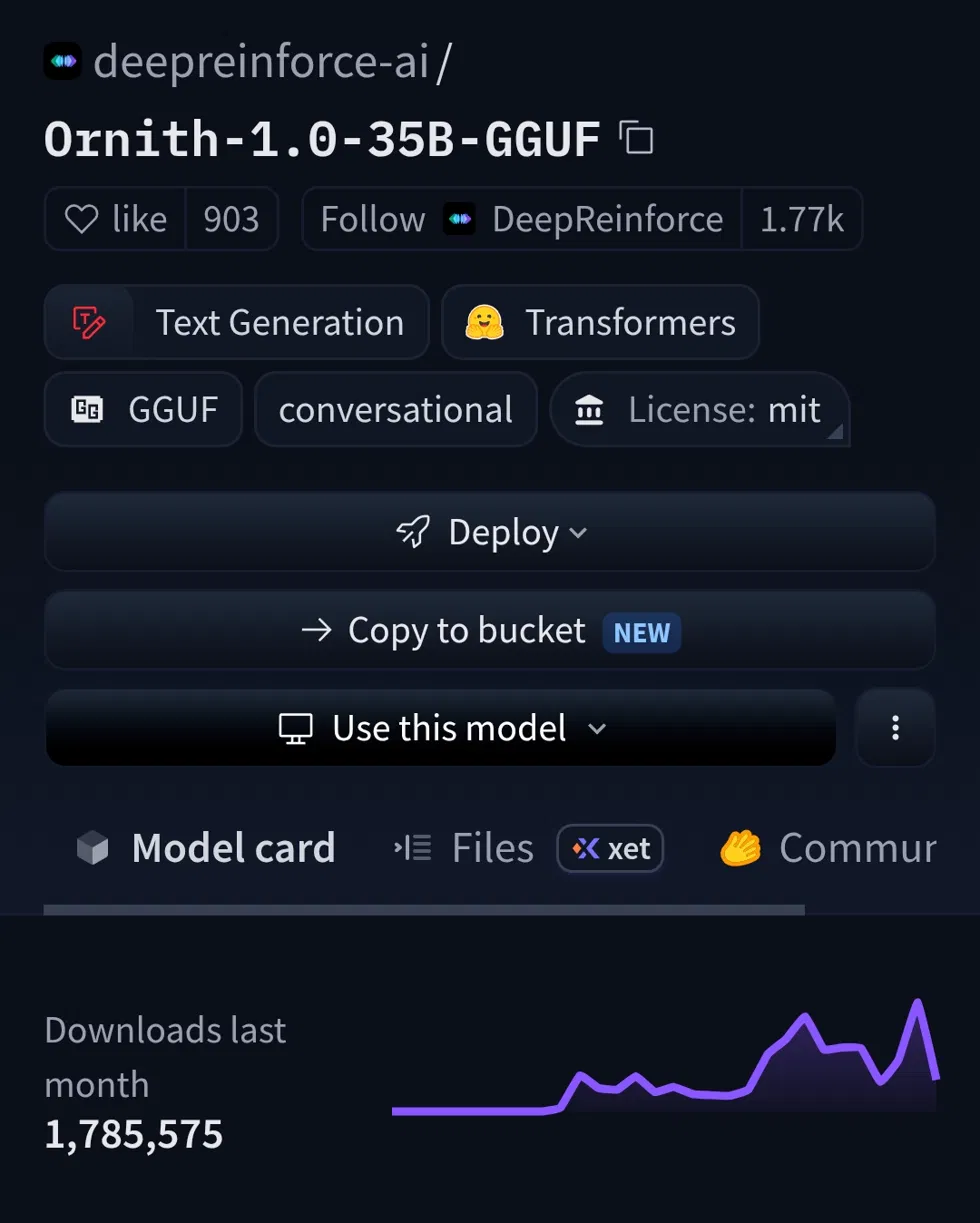
That 1.785 million downloads figure from the Hugging Face card is worth pausing on. That’s not a research curiosity number. That’s real developers running this in real workflows, which is the most honest usage signal available right now.
Best YouTube tutorial for this: 👉 https://www.youtube.com/watch?v=SDme6CQCX2E “Ornith 1.0 Tutorial:- How To Install and Use Ornith 1.0 (Opus Level Coding Locally)” by The AI Grid. Practical install walkthrough, covers LM Studio setup, genuinely useful if you want to see the full process before committing your weekend to it.
Who Should Actually Use This
Real talk on who this is and isn’t for:
Use Ornith-1.0 if you: Work in a company where sending code to a third-party API is a compliance problem. Are tired of paying monthly API costs for agentic coding and want a free alternative. Already work in the terminal and are comfortable with vLLM or LM Studio setup. Are building your own agent framework and need an OpenAI-compatible model with tool-calling built in. Have a 24GB+ GPU available for the 35B, or an 80GB GPU for the full bf16 9B.
Skip Ornith-1.0 if you: Need the absolute ceiling of coding performance right now. Claude Opus 4.8 genuinely scores higher. Need a 1M-token context window for enormous codebases. Ornith tops out at 256K. Want a GUI that works like Cursor. This is terminal-native. Haven’t done local model serving before and don’t want to figure out vLLM or llama.cpp. Aren’t a developer at all. This isn’t designed for non-technical use.
If you’re evaluating Ornith partly because you want to build agentic coding into a freelance service or consulting practice, our AI agent freelancing honest review has the real rate data on what that kind of work pays right now.
Is Ornith 1.0 Actually Worth It?
For the right developer, genuinely yes. Score: 4/5
Worth it if you want agentic coding without monthly API bills, if you need your code to stay on your own hardware, or if you’re building a custom agent framework and need a capable open-weights model with tool-calling baked in. The 35B MoE at Q4_K_M quantization (~20GB) is the realistic sweet spot for most people, good benchmark scores, manageable hardware requirements, MIT license with no restrictions.
Not worth it if you need Claude Opus 4.8-level performance, a 1M context window, or a polished GUI. Those things just don’t exist in Ornith-1.0 right now. The benchmark numbers are also still vendor-reported only, so if you need third-party verified accuracy claims before deploying something, you’ll want to wait a few more months for independent evals to catch up.
But for developers who care about cost, privacy, and are comfortable in the terminal? This is one of the better free tools to come out of the open-source coding space in 2026.
FAQ
1. Is Ornith-1.0 worth it for developers? For developers who want free, privacy-first agentic coding without monthly API costs, yes. The 35B MoE variant runs locally on a 24GB GPU with GGUF builds, carries an MIT license with no commercial restrictions, and posts competitive benchmark numbers for an open-source model. If you need top-of-market performance, Claude Opus 4.8 still wins on independent benchmarks.
2. How does Ornith-1.0 compare to Claude Code? Ornith-1.0 is free and self-hostable under MIT license while Claude Code always calls Anthropic’s paid API. Claude Opus 4.8 scores higher on SWE-Bench Verified (87.6 vs 82.4) and has a 4x larger context window (1M vs 256K tokens). Ornith wins on cost, data privacy, and no-vendor-lock-in.
3. What does self-scaffolding mean in Ornith-1.0? Instead of following a fixed, human-written workflow for each coding task, Ornith-1.0 learns to write its own approach during reinforcement learning training. It jointly figures out the best search strategy for each specific problem and then executes it, which is what makes it different from most agentic coding models.
4. What hardware do I need to run Ornith-1.0? The 9B Dense model in bf16 needs ~19GB, fitting on a single 80GB GPU or quantized for consumer hardware. The 35B MoE Q4_K_M GGUF weighs ~20GB and runs on a 24GB GPU. The 397B MoE flagship needs serious multi-GPU infrastructure. For most developers, the 9B or 35B are the realistic starting points.
5. Is Ornith-1.0 better than Aider? They solve different problems. Aider is a coding workflow tool you attach any model to, including Ornith-1.0 itself. Ornith-1.0 is the model, built specifically for agentic, autonomous coding tasks. Aider gives you more control and transparency over each edit. Ornith’s self-scaffolding makes it stronger at fully autonomous, multi-step problem-solving without human checkpoints at every step.
- Claude Sonnet 5 for Developers Review, covers the Claude model family that Ornith-1.0 benchmarks against.
- GPT 5.6 vs Grok 4.5 vs Claude: Which Is Better?, the full frontier model landscape where Ornith is trying to compete.
- Is AI Agent Freelancing Actually Worth It?, real rate data if you want to turn agentic coding skills into income.
- Does Claude Cowork Actually Replace ChatGPT Enterprise?, relevant if you’re evaluating Ornith as part of a broader enterprise AI tool decision.
Related Web Stories:
- Claude vs Grok 4.5 vs GPT-5.6: Who Wins?
- Why Claude Now Wants Your Government ID
- The AI Squish Trend, Tested and Explained
1 thought on “Is Ornith 1.0 Worth It for Developers? Honest Review”