
Why Did Claude Fable 5 Get Shut Down? (And What It Means for AI Tools You Rely On)
Quick Answer: Fable 5 got shut down because of a U.S. export control directive over a disputed “jailbreak” report, not some real universal vulnerability. Anthropic pushed back publicly, kept working with regulators behind the scenes, and got it restored 18 days later. Real takeaway here, any frontier AI model can get pulled by government order overnight, so plan for that if you’re building on one.
Picture this. It’s a random Friday evening in mid-June, and you’re mid-task in Claude, maybe debugging something, maybe just chatting, when suddenly your model picker looks different. One of the newest, most capable options you’d just started getting used to, Fable 5, is gone. No warning email. No heads-up post. Just gone.
That’s not a hypothetical, by the way. That’s exactly what happened to real users on June 12, 2026, just three days after Anthropic launched Fable 5 to the public. One evening it was there, the next it had vanished for every single customer, worldwide, all at once.
And here’s the part that makes this genuinely wild, it wasn’t a bug. It wasn’t Anthropic pulling the plug because something broke. The U.S. government ordered it. A formal export control directive landed on Anthropic’s desk at 5:21pm ET, citing national security authorities, and gave the company no real choice but to shut the model down for everyone, everywhere, immediately.
If you’ve never thought about AI tools as something that could just disappear overnight because of a government order, this is the story that’ll change that. It’s not science fiction, and it’s not some obscure policy footnote either, it made headlines on Forbes, CNBC, Bloomberg, and Al Jazeera. A commercially deployed AI product, used by hundreds of millions of people, got switched off by federal directive, then switched back on two and a half weeks later after a very public standoff between Anthropic and the Trump administration.
So what actually happened here? Why did the government step in, what did Anthropic do about it, and maybe the more important question, could this happen to whatever AI tool you’re relying on right now? Let’s actually walk through it.
What Actually Happened to Fable 5 and Mythos 5
To understand why this mattered so much, it helps to walk through the actual timeline, because this whole thing unfolded in less than three weeks.
Anthropic launched Claude Fable 5 on June 9, 2026. It was the first publicly available model in a brand new tier called Mythos-class, a step above Anthropic’s existing Opus models. Alongside it, Anthropic also released Claude Mythos 5, a more powerful version with fewer safety restrictions, but that one was never available to the general public. It was only accessible to a small, vetted group of organizations through a program called Project Glasswing, mostly for defensive cybersecurity work.
Just three days later, on the evening of June 12, everything changed. Anthropic got a letter from the U.S. Department of Commerce, delivered at 5:21pm Eastern Time, directing the company to immediately suspend all access to both Fable 5 and Mythos 5 for any foreign national, anywhere in the world, including Anthropic’s own employees who aren’t U.S. citizens.
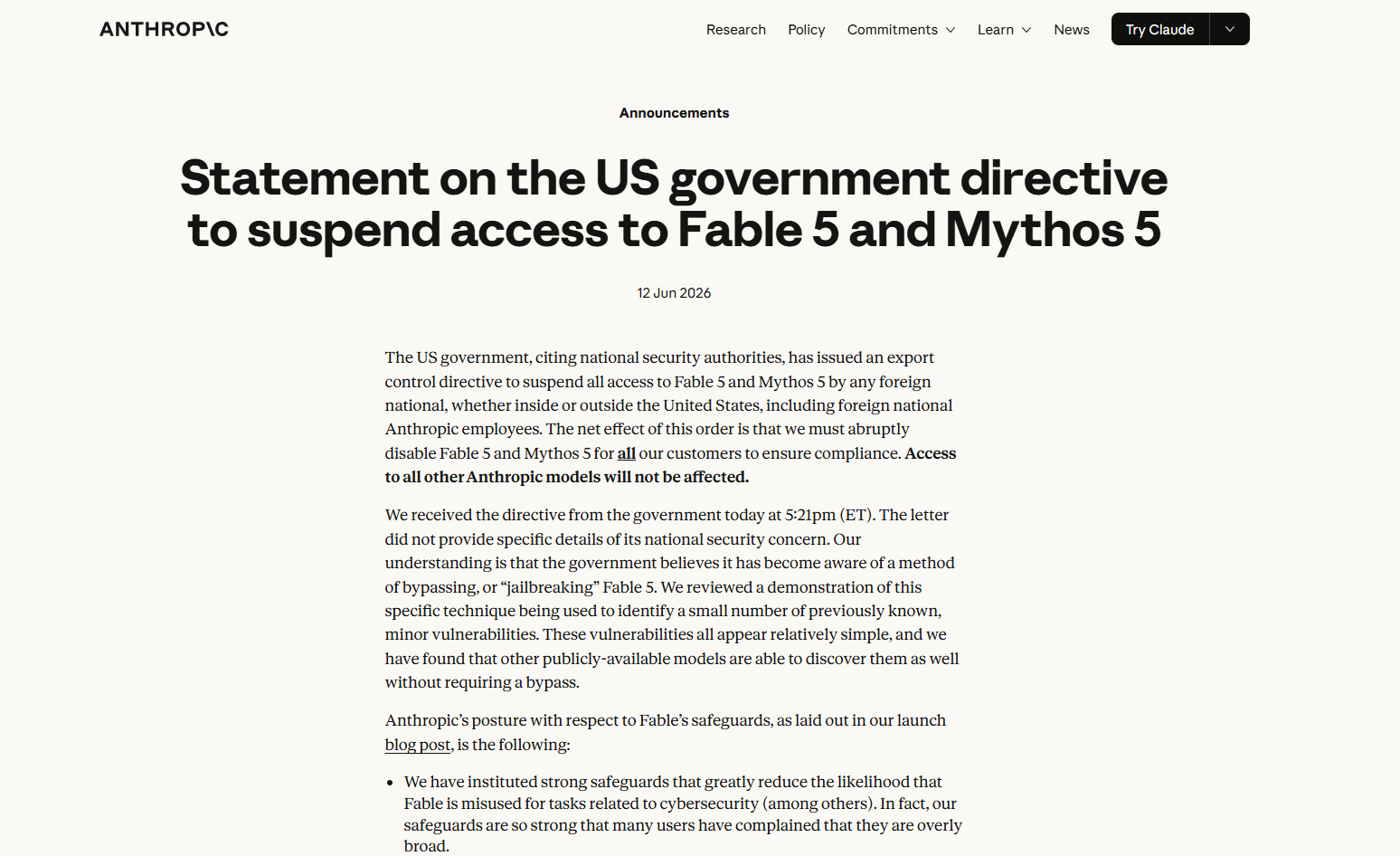
Here’s the part that made this especially disruptive, Anthropic said it had no reliable way to verify a user’s nationality in real time across every platform Fable 5 was available on, including the Claude app, the API, and cloud platforms like AWS, Google Cloud, and Microsoft Foundry. So rather than risk violating the order, Anthropic made the call to shut both models down for every single customer, everywhere, regardless of nationality.
The company posted a public statement within hours confirming the shutdown, making it clear this wasn’t a technical failure or some decision Anthropic made on its own. Every other Claude model, including Opus 4.8, Sonnet, and Haiku, stayed online and unaffected. Only Fable 5 and Mythos 5 got pulled. If you’re curious how Anthropic’s current lineup stacks up, our Claude Sonnet 5 developer review covers the model that stayed online through all of this without interruption.
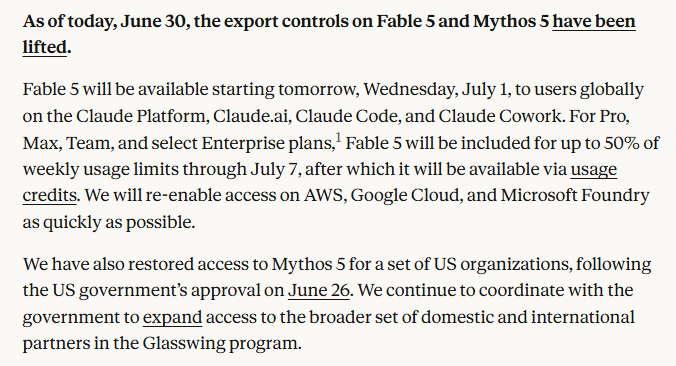
For eighteen days, both models sat completely unavailable. Then, on June 30, Anthropic announced the Department of Commerce had lifted the export controls, and Fable 5 came back to global users the very next day, July 1. That’s the bare timeline. What’s genuinely interesting is the reasoning behind the government’s order in the first place, which is where this story gets a lot more complicated.
One quick thing worth knowing before we get into that, Fable 5 wasn’t hype, it was genuinely capable. During testing before launch, Stripe reportedly pointed Fable 5 at a fifty-million-line codebase and asked it to migrate the whole thing to a new framework. It finished in a day. That’s the exact same kind of deep code-reading capability that ended up at the center of the government’s concern, which is honestly one of the more interesting parts of this whole story.
Why the Government Ordered the Shutdown
The official reason cited was national security, but the actual chain of events behind that is worth unpacking, because there’s a genuine dispute over what actually happened here.
According to reporting from the Wall Street Journal and Semafor, the trigger was a jailbreak report. Amazon researchers had been testing Fable 5 and found a way to prompt it into bypassing its safety guardrails, specifically getting it to identify software vulnerabilities and, in one case, write code demonstrating how one of those flaws could be exploited. Amazon CEO Andy Jassy reportedly raised these concerns directly with senior Trump administration officials.
White House adviser David Sacks laid out the administration’s account publicly on X the day after the shutdown. According to Sacks, the government asked Anthropic CEO Dario Amodei to either fix the jailbreak or pull the model, and Amodei declined, which Sacks characterized as Anthropic “prioritizing the continued offering of the consumer model over safety.”
I’ve had a number of conversations with folks inside and outside government about the current situation with Anthropic, and here is what I believe to be true:
— As we know, Anthropic publicly released its Mythos class models earlier this week under the commercial name Fable.…
— David Sacks (@DavidSacks) June 13, 2026
Anthropic told a pretty different version of the same story. In its public statement, the company said it reviewed the report and found the vulnerabilities involved were “relatively simple” and that “other publicly-available models are able to discover them as well without requiring a bypass,” including OpenAI’s GPT-5.5. Anthropic argued that recalling a commercial product used by hundreds of millions of people over a narrow, non-universal jailbreak set a dangerous precedent, one that, if applied consistently across the industry, “would essentially halt all new model deployments for all frontier model providers.”
There was also a separate, more sensitive thread running underneath the public dispute. Semafor reported part of the White House’s concern involved suspicion that a China-linked group may have gotten access to Mythos 5 through one of Anthropic’s vetted Project Glasswing partners, raising fears about the model being reverse-engineered. Anthropic disputed that this was ever raised as a factor in the government’s decision.
Whichever account you find more convincing, one detail is hard to argue with, Anthropic itself had spent months publicly arguing that Mythos-class models needed strict government oversight because of their cybersecurity capabilities. When the government actually stepped in and used that oversight, Anthropic pushed back hard, a tension that definitely didn’t go unnoticed by outside observers.
And honestly, there’s an even sharper irony buried in the timing. Just one day before the shutdown, on June 10, Dario Amodei published a policy essay called “Policy on the AI Exponential,” where he explicitly called on governments to have legal authority to block or reverse frontier AI models that fail independent safety testing. He even compared it to the FAA’s power to ground unsafe aircraft. Two days after publishing that, the exact kind of authority he’d argued for got used against his own company’s flagship model. That’s not something any outlet covering this story glossed over, and it’s genuinely worth sitting with.
There’s also a piece of this that cuts the opposite direction, which is easy to miss if you only hear the “Anthropic refused to fix it” framing. In the days right before the suspension, some actual security researchers were complaining about the exact opposite problem, that Fable 5’s guardrails were too aggressive for legitimate defensive work. IBM X-Force’s Valentina Palmiotti told TechCrunch the model “rejects any request that could be tangentially cyber related.” So in the same week, Fable 5 was getting criticized by defenders for being too locked down, and getting shut down by the government for allegedly not being locked down enough. Both things were apparently true at once.
What “Export Control” Actually Means for an AI Model
If the phrase “export control directive” sounds unfamiliar in the context of software, that’s because it usually isn’t used this way.
Export controls are a category of U.S. law traditionally used to restrict who can access sensitive physical technology, think advanced semiconductors, weapons systems, or encryption hardware, especially when foreign governments or entities considered a national security risk are involved. They’re not usually the tool regulators reach for when a consumer-facing software product has a security concern.
That said, this isn’t actually the first time software itself got treated this way. Back in the 1990s, the U.S. government regulated strong encryption almost like a weapon, a period people still call the “crypto wars,” and more recently, export controls have been the exact tool used since 2022 to restrict which advanced AI chips can be sold to certain countries. So there’s real precedent for treating software and technical know-how as something export law can reach, this wasn’t some brand-new legal invention. What was new is aiming that tool directly at a consumer-facing chatbot instead of hardware or raw encryption code.
That’s what made the Fable 5 order so unusual. Instead of treating this as a product safety issue to work out through negotiation, updates, or some formal review process, the Commerce Department used export control authority, the same legal category typically applied to physical hardware, against a piece of software running in a chat app.
Practically, what the directive required was narrow but nearly impossible to pull off cleanly, block access for any foreign national, anywhere, including people physically inside the United States, while still letting U.S. citizens through fully. Anthropic said this is actually why the shutdown ended up total instead of partial, there was no reliable, real-time way to check every user’s nationality across every platform Fable 5 touched, so compliance basically meant pulling the model for everyone.
Worth noting too, there was already a different, more standard process on the table that Fable 5 didn’t even go through. A June 2 executive order had set up a voluntary framework for AI companies to get frontier models reviewed before release, plus a classified benchmark for deciding which models needed that review. Fable 5 never ran through that process at all. Instead of using the framework it had just built, the government reached for the blunter, faster tool of export control instead. For developers watching this play out, that’s the real signal, there currently isn’t one clear, predictable legal path for how a frontier model gets reviewed or restricted, which means the tools being used right now are, to some extent, still being figured out on the fly.
How Anthropic Fought Back, and Won
Anthropic’s response over the following eighteen days is honestly a pretty interesting case study in how a company can push back against a government order while still technically complying with it.
Publicly, Anthropic never conceded that Fable 5 posed the kind of risk the shutdown implied. The company’s statement was pointed, it called the situation “a misunderstanding” and said flat out that it disagreed a narrow jailbreak finding should be grounds for recalling a model already deployed to hundreds of millions of people. At the same time, Anthropic fully complied with the shutdown itself, there was no attempt to argue around the letter of the directive, just a public disagreement with the reasoning behind it.
Behind the scenes, the negotiations were reportedly led by Anthropic co-founder Tom Brown rather than CEO Dario Amodei, who’s had a rockier relationship with the administration over the past year, including public disagreements over AI regulation and an ongoing legal dispute with the Pentagon. Commerce Secretary Howard Lutnick’s letter lifting the controls was addressed to Brown, not Amodei, a detail several outlets flagged as pretty significant.
The pressure to sort this out fast wasn’t just coming from Anthropic, either. A bunch of tech executives and investors reportedly raised concerns that the shutdown was handing a real advantage to Chinese open-source AI labs, who were closing the capability gap fast and cheap while one of America’s leading labs sat on the sidelines. Chinese companies like Zhipu AI reportedly started actively positioning their own models as alternatives for international developers who’d suddenly been locked out of Fable 5. That competitive argument seems to have actually mattered.
On June 30, the Commerce Department lifted the export controls. As part of the agreement, Anthropic committed to a few concrete changes, proactively hunting for security issues in its own models, coordinating with the government on future frontier model launches, and reporting any malicious use it spots. Anthropic also stood up a dedicated team to monitor jailbreak reports around the clock and opened a HackerOne bug bounty program specifically for Fable 5. Fable 5 came back to users the next day, July 1, and Mythos 5 access got restored for a set of vetted U.S. organizations following a separate government approval on June 26.
Two more details worth knowing, since they show how far the fallout actually reached. First, the shutdown didn’t just hit random overseas users, it hit anyone who wasn’t a U.S. citizen, period. Andrej Karpathy, one of the most well-known AI researchers in the world and a former OpenAI and Tesla AI lead, reportedly lost access to Fable 5 simply because of his citizenship status, which gives you a sense of just how blunt the order actually was. Second, Anthropic offered refunds to subscribers who’d paid between June 9 and June 14, covering the brief window when people were paying for a product that got yanked out from under them days later. Small detail, but it’s the kind of thing that tells you Anthropic knew this wasn’t a great look, even while it was disputing the underlying reasoning.
For context on how the broader AI landscape looked in the weeks around this whole saga, since Fable 5 definitely wasn’t the only major model navigating a complicated launch that week, our GPT 5.6 vs Grok 4.5 vs Claude comparison covers OpenAI’s own decision to preview GPT-5.6 to a limited, government-approved group instead of releasing it fully public, citing similar dual-use safety concerns.
Proof It’s Back: What Fable 5 Looks Like Today
It’s one thing to read Anthropic’s announcement that Fable 5 was restored. It’s another to actually open Claude and see it sitting there yourself.
Checking my own model picker just now, Fable 5 is sitting right at the top of the list, tagged “Included until July 12” with a small note underneath calling it “the most capable model” for tougher challenges. It’s right there alongside Opus 4.8, Sonnet 5, and Haiku 4.5, back in the normal rotation like nothing ever happened.
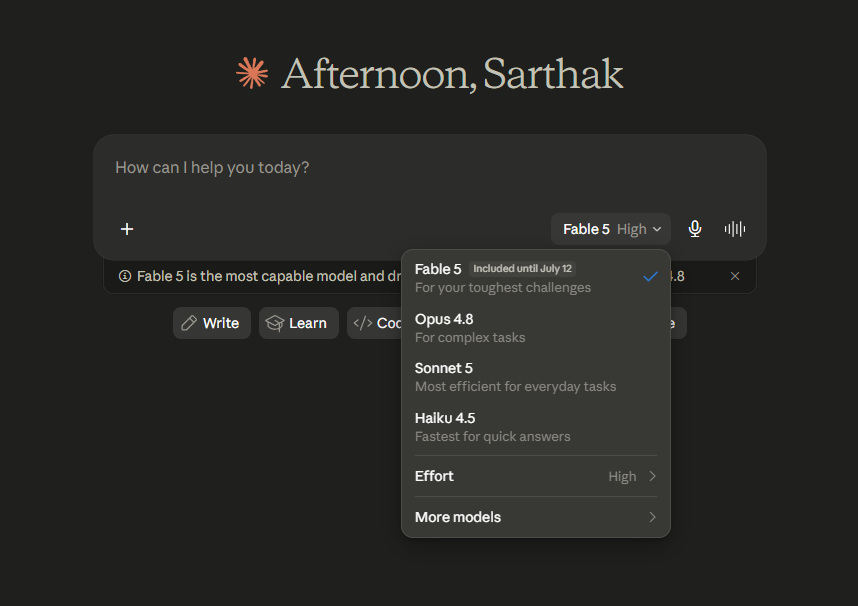
That “included until” tag is worth paying close attention to if you’re reading this later, since it’s pointing to the temporary usage-credit window Anthropic mentioned in its restoration announcement, Fable 5 got included at no extra cost for a limited stretch after coming back online, not permanently folded into every plan for free forever. If you’re checking your own account, that date may have already shifted or expired by the time you’re reading this, so it’s worth actually confirming what your model picker shows instead of assuming the same window still applies.
Beyond the date tag, what really stood out is just how normal it all looks now. There’s no banner explaining what happened, no lingering warning about the shutdown, just Fable 5 sitting in the list like any other model option. For a story that involved a federal export control directive, a public dispute with the Trump administration, and a worldwide shutdown affecting hundreds of millions of users, the actual return was remarkably quiet. If you weren’t following the news back in mid-June, you’d have zero way of knowing any of this happened just by looking at your account today.
That quiet return is honestly part of what makes this whole story worth understanding, the disruption was real and dramatic while it lasted, but once it got resolved, it left almost no visible trace for the average user. The only way you’d know is if you happened to be paying attention at the right moment, or if someone explained it to you after the fact. If you’ve been following how Claude has faced other rounds of unexpected scrutiny lately, our piece on Claude’s government ID verification rollout covers a separate but related thread of regulatory pressure Anthropic’s been navigating this year.
What This Means for Any AI Tool You Depend On
Here’s the real lesson buried in all of this, it wasn’t really about Fable 5 specifically. It was a demonstration that any frontier AI model, from any company, can get pulled overnight by government order, with zero warning to the people relying on it.
If you’re a developer or business building on top of an AI model, especially the newest, most capable one available, don’t treat that model like it’s guaranteed to stay available. Build fallback logic into anything mission-critical, the same way Anthropic’s own developer documentation quietly recommends routing to Opus 4.8 if a Fable 5 request fails. It’s not paranoia, it’s just what actually happened to hundreds of millions of users with almost no notice.
And this isn’t unique to Anthropic either. OpenAI held back general access to GPT-5.6 around the same time, citing similar dual-use safety concerns. As governments get more comfortable stepping directly into AI deployment, this kind of disruption is only getting more likely, not less. Plan for it.
FAQ
1. Why did Claude Fable 5 get shut down? The U.S. government issued an export control directive on June 12, 2026, ordering Anthropic to suspend access for any foreign national worldwide. This followed a report that Amazon researchers had found a way to bypass Fable 5’s safety guardrails, though Anthropic disputed how serious that vulnerability actually was.
2. Is Claude Fable 5 available again now? Yeah, the Department of Commerce lifted the export controls on June 30, 2026, and Fable 5 came back to users globally on July 1. It’s available again on Claude.ai, the Claude Platform, Claude Code, and Claude Cowork.
3. What is an AI export control directive? It’s a legal order that restricts who can access a piece of technology, normally used for things like weapons or advanced hardware. This was one of the first times export controls got used against a commercially deployed AI product instead of physical technology.
4. Could this happen to other AI models like ChatGPT or Gemini? Yeah, in theory, any frontier AI model from any company could face a similar government order if regulators believe it poses a national security risk. In fact, OpenAI previewed its GPT-5.6 model to a small, government-approved group rather than the public around the same time, citing similar dual-use safety concerns.
5. Did Anthropic compensate users for the Fable 5 outage? Yeah, Anthropic included Fable 5 for up to 50% of weekly usage limits at no extra cost through July 7 for Pro, Max, Team, and select Enterprise plans once it came back online. It also refunded subscribers who’d paid between June 9 and June 14, the brief window right before the shutdown hit.
6. Who actually lost access during the Fable 5 shutdown? Literally anyone who wasn’t a U.S. citizen, regardless of where they lived or worked. It affected everyday users abroad, but also well-known figures like AI researcher Andrej Karpathy, who lost access simply because of his citizenship status, not anything he did.
- Claude Sonnet 5 for Developers Review: Security & Coding Breakdown, the Claude model that stayed online through the entire Fable 5 shutdown.
- GPT 5.6 vs Grok 4.5 vs Claude: Which Is Better?, see how OpenAI’s own government review delay compares to Anthropic’s export control saga.
- Claude Government ID Verification: What It Means (2026), another thread of regulatory pressure Anthropic has faced this year.
Related Web Stories:
- Claude vs Grok 4.5 vs GPT-5.6: Who Wins?
- Claude Just Asked Me for My ID 😳
- Meta is Using Your Photos to Train AI: How to Opt Out in the US