

How to Make Money With AI Instead of Losing Job to It?
Quick Answer: AI really is the #1 cited reason for U.S. layoffs right now, four months running. But the same data shows people who actually use AI themselves are less likely to get laid off, and real income exists in AI freelancing, consulting, and reskilling. The honest path is boring: pick one skill, use AI to do it faster, stick with it 3-6 months.
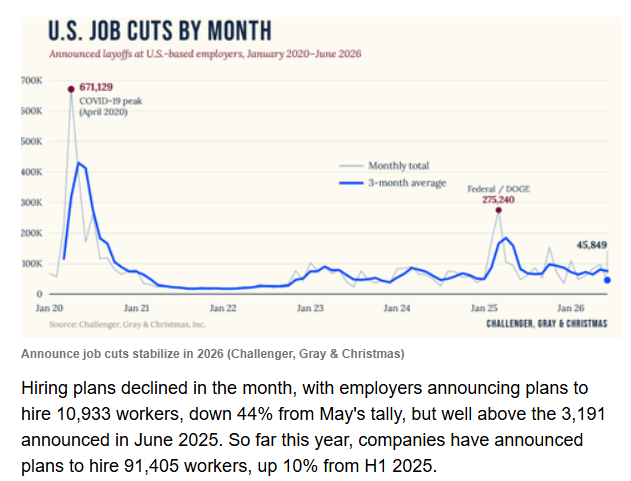
Okay, so let’s just start with the number that’s genuinely hard to argue with. AI has now been the single most-cited reason for job cuts in the U.S. for four straight months in a row, something that’s literally never happened before in the data. Tech companies alone announced 139,156 job cuts in the first half of 2026, up 83% from the same stretch last year. That’s not a vibe, that’s not a scary headline someone made up, that’s Challenger, Gray & Christmas, the outplacement firm that’s been tracking this stuff for decades.
So yeah, if you’re feeling nervous about your job right now, or you already lost it, you’re not being paranoid. Something real is happening.
But here’s the thing nobody’s honest about, and it’s the whole reason I wanted to write this. A huge chunk of the content out there about “making money with AI” is either doom-scrolling bait designed to scare you into clicking, or it’s some Medium post with a sketchy affiliate link promising you’ll go from “jobless and stressed to financially free in weeks.” Neither of those actually helps you. One just makes you anxious, the other just takes your money.
What I actually wanted to know, and what this article’s actually about, is simpler than either of those. Is the AI layoff thing as bad as it sounds? Is any of it actually avoidable? And if you do want to earn money with AI instead of just being a casualty of it, what does that realistically look like, with real numbers, not “$20-25/hour, click here” nonsense?
Let’s get into the real data first, then the real ways people are actually doing this.
The Real Numbers: How Bad Is the AI Layoff Wave Actually?
Let’s just lay out what’s actually happened this year, since the exact numbers matter more than the vague headlines.
AI has been the top cited reason for U.S. layoffs for four consecutive months as of the most recent Challenger report. In May 2026 alone, AI was blamed for nearly 40% of all announced job cuts, the highest single-month share ever recorded since Challenger started tracking this specific category back in 2023. For the full year so far, AI’s been cited in over 100,000 layoffs, already blowing past the entire total for 2025.
Tech is getting hit hardest, by a lot. Technology companies announced 139,156 job cuts in the first half of 2026 alone, up 83% year over year, and now account for close to a third of every single layoff announced in the U.S. this year. Some of the names involved are companies most people recognize, Meta cut about 8,000 jobs in May while simultaneously raising its AI spending guidance to $115-145 billion. Block, run by Twitter co-founder Jack Dorsey, cut nearly half its workforce, about 4,000 people, and Dorsey said directly in a shareholder letter that “intelligence tools have changed what it means to build and run a company.” Block’s stock jumped nearly 14% the next day.
That last detail’s worth sitting with for a second. A company cuts 40% of its staff, blames AI, and the stock market rewards it immediately. That’s part of why so many companies are reaching for the same explanation right now, whether or not AI is actually the real driver in every single case.
Which brings up the honest complication in all of this: not everyone agrees AI is really the reason behind most of these cuts, and that skepticism is worth taking seriously too, which is exactly what we’ll get into next.
Wait, Is AI Really the Reason? (The Skeptics’ Case)
Here’s where it gets genuinely complicated, and honestly, more reassuring than the headlines make it sound.
OpenAI’s own CEO, Sam Altman, has publicly acknowledged what he calls “AI washing,” saying “almost every company that does layoffs is blaming AI, whether or not it really is about AI.” Venture capitalist Marc Andreessen made the same point even more bluntly in a conversation with podcaster Harry Stebbings, arguing that most large companies are massively overstaffed from pandemic-era hiring, somewhere between 25% and 75% overstaffed by his estimate, and that “now they all have the silver bullet excuse: Ah, it’s AI.” Wharton professor Peter Cappelli put it just as plainly, pointing out that when you actually read what companies say instead of just the headline, it’s usually something closer to “we expect AI will cover this work” rather than proof that it already has.
There’s real research backing this skepticism up too. Oxford Economics concluded in a January 2026 report that firms “don’t appear to be replacing workers with AI on a significant scale.” And a Gartner study surveying 350 global executives at companies with at least $1 billion in revenue found something genuinely striking, among organizations piloting or deploying AI, roughly 80% had reduced their workforce, but none of those cuts actually correlated with better financial returns. The companies actually seeing strong results from AI weren’t the ones cutting people, they were the ones retraining and redesigning roles instead, something Gartner calls “people amplification.”
So what’s the honest read here? It’s probably some of both. AI genuinely is changing what some jobs require, especially at the entry level, Stanford HAI’s 2026 AI Index found employment for software developers aged 22-25 has dropped nearly 20% since 2024, while developers 30 and older at the same companies actually grew in headcount. At the same time, “AI” has clearly become a convenient, stock-price-friendly story for cuts that might have happened anyway due to overhiring, high interest rates, or just standard cost-cutting.
Either way, the practical result for you is the same. Whatever the real mix of causes, hundreds of thousands of real people are genuinely losing real jobs right now, and understanding that it’s not purely a clean, simple “robots took my job” story doesn’t change what you actually need to do next.
Block is laying off ~half of their staff due to advances in AI.
This is one of the first major examples of AI driving layoffs, but certainly not the last.
If you’re saying “this won’t happen to me”, re-evaluate your thoughts.
Now.
It may be the most important thing you do. https://t.co/RSz7KfIHnJ
— Matt Shumer (@mattshumer_) February 26, 2026
The Flip Side: Using AI Might Actually Protect Your Job
Here’s the genuinely useful twist that barely anyone’s talking about, and it might be the single most important stat in this whole article.
Gallup research found that workers who never use AI are actually more likely to get laid off than workers who use it regularly. Specifically, 62% of laid-off workers turned out to be non-users of AI, people who used it once a year or less, compared to only 50% of currently employed workers. Among tech workers specifically, the gap was even starker, tech employees using AI monthly or less were three times more likely to have been laid off (18%) compared to tech workers using it at least monthly (6%). That pattern held up even after Gallup controlled for age, education, industry, and how long ago someone was laid off.
There’s another detail worth knowing that cuts against the scary headlines too, when Gallup actually asked laid-off workers themselves why they lost their job, only about 1% mentioned AI or automation directly. Most pointed to plain old organizational restructuring and downsizing instead. That doesn’t mean AI played zero role behind the scenes, companies clearly are restructuring around it, but it does mean the “AI personally replaced me” story is a lot rarer than the headlines suggest.
Put those two things together and you get a genuinely actionable takeaway: becoming someone who actively uses AI in your current job isn’t just a hedge against boredom, it’s showing up in the actual layoff data as a protective factor. IBM’s a good real-world example of this in action, the company replaced roughly 200 HR positions with AI agents while simultaneously tripling its entry-level hiring specifically for AI-oversight roles. The jobs disappearing and the jobs appearing aren’t random, they’re shifting toward people who can actually work alongside AI rather than people who’ve never touched it.
So if you’re currently employed and nervous, step one isn’t necessarily updating your resume. It might just be actually opening up an AI tool at work and using it for real tasks, starting today.
Real Ways People Are Actually Earning With AI Right Now
Okay, so here’s the part that actually matters, if you want AI to be an income source instead of just a threat, what does that genuinely look like? Here’s a comparison of the three realistic paths, based on real, verifiable data, not vague promises.
| Feature | AI Freelancing (Upwork/Fiverr) | AI Consulting/Implementation | Reskilling/Certification Programs |
|---|---|---|---|
| Startup Cost | Basically $0, just your time and existing skills | Low, mostly your own expertise plus maybe a website | Varies widely, free (YouTube, docs) to a few thousand dollars for bootcamps/certs |
| Key Features | Real job listings with visible pay ranges, work starts almost immediately | Higher pay ceiling, helping businesses actually implement AI tools/workflows | Structured learning path, credentials some employers actually recognize |
| Best Use Case | Fastest way to test if there’s real demand for your specific skill | People who already have deep expertise in a field AI is disrupting | People starting from scratch who need structure before freelancing or consulting |
I actually went and checked real Upwork listings for this instead of just guessing. Searching “AI agents” directly on the platform, Upwork’s own data showed a typical hourly rate range of $15 to $60 an hour. But looking at real freelancer profiles that came up as strong matches, the spread was way wider, one freelancer listed at $150/hour with a 5.0 rating across 49 reviews, another at $200/hour with a smaller but perfect 3-review record, and a third at $49/hour with 41 reviews.
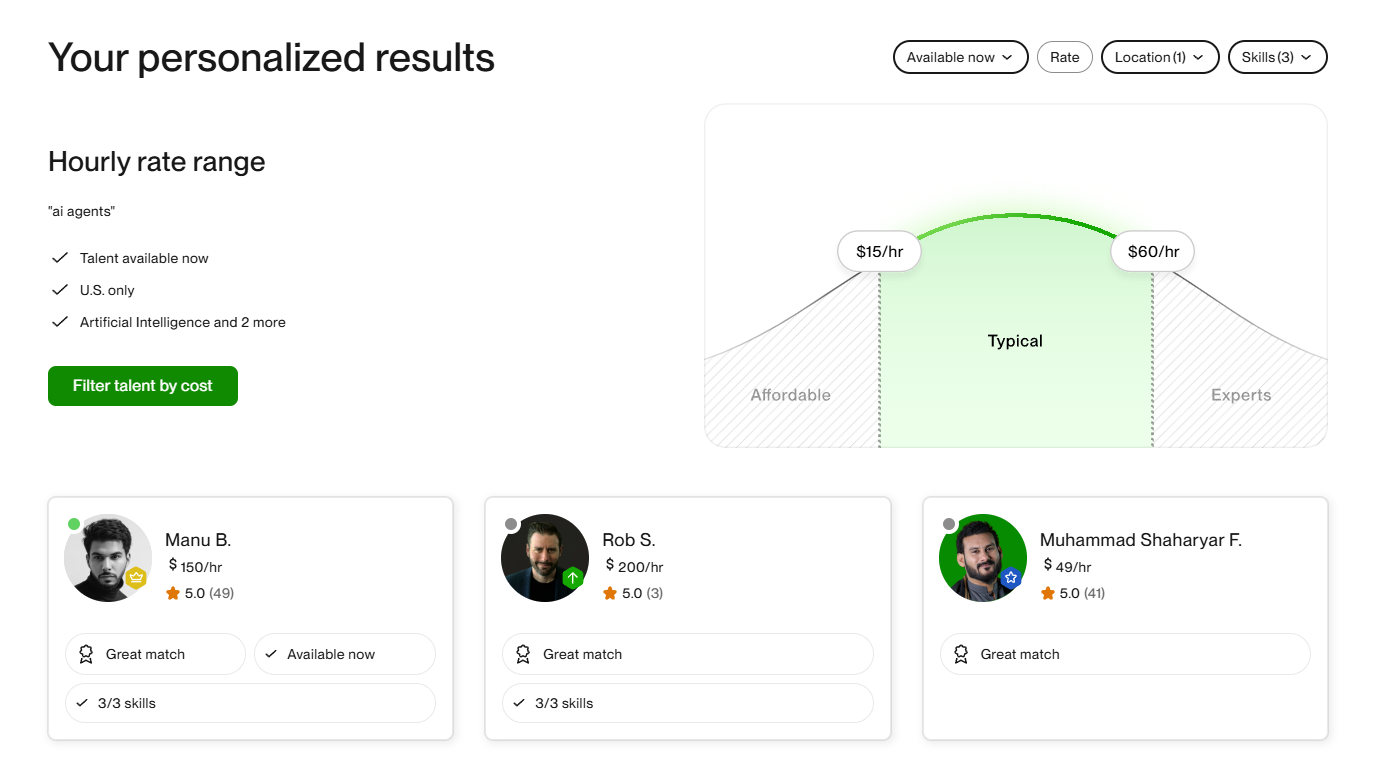
That’s a genuinely wide range, and it tells you something honest, the rate you can actually charge depends almost entirely on whether you’re offering something generic versus something specific and technical. It’s the same pattern we found digging into AI agent freelancing specifically, the people earning real money aren’t doing vague “AI stuff,” they’ve picked one specific, well-defined service.
On the entrepreneurship side, there’s a genuinely encouraging stat worth knowing too, almost 25% of laid-off tech workers go on to start their own businesses, a 67% increase in post-layoff ventures compared to the year before. And here’s a detail that should make that feel a lot more doable than it sounds, most people estimate they’d need around $28,000 to start a business. The actual median startup cost is closer to $12,000. If you got any severance at all, you likely have more runway than your gut is telling you, especially once you calculate it honestly (subtract taxes, figure your real monthly burn rate, and assume zero income for at least the first three months).
The Red Flags: Scammy “AI Money” Content to Avoid
Here’s something worth being genuinely blunt about, since it’s a real gap in almost every other article covering this topic. A huge amount of what shows up when you search “make money with AI” is not helpful, it’s actively predatory, and it’s specifically targeting people who are scared and vulnerable after losing a job.
While researching this article, I found post after post following the exact same script: a first-person “I lost my job to AI too, but then I found this one trick” story, followed by a link to some vague “system,” followed by a claim like going “from jobless and stressed to financially free in just a few weeks.” That’s not a real strategy, that’s a template scammers reuse constantly, and the fact that it’s specifically aimed at people in a moment of real financial stress makes it worse, not better.
Here’s how to spot it. Watch for anything promising a specific dollar amount with almost no explanation of the actual work involved (“$20-25/hour, click here”). Watch for testimonials that sound too clean, no bad weeks, no real numbers, just a vague success story and a link. And watch for anything that requires you to pay for access to a “proven system” before you’ve earned a single dollar, that’s the business model, and it’s not yours.
Real AI income, freelancing, consulting, reskilling, all of it takes actual time and actual skill-building. It’s genuinely less exciting than “click here and go financially free in weeks,” but it’s real, and that’s worth more than a promise that isn’t.
So, Is It Actually Worth Pivoting to AI-Powered Income?
Honestly, yeah, for most people, this is worth taking seriously, whether you’ve already been laid off or you’re just nervous about your current job.
It’s worth it if you’re willing to treat this like an actual skill-building project, not a lottery ticket. Pick one thing, freelancing in a specific niche, consulting in your existing field but AI-enhanced, or a structured reskilling path, and give it real time, 3 to 6 months minimum, before judging whether it’s working. The data backs this up on both ends, AI genuinely is displacing real jobs, and real people genuinely are earning real income by leaning into it instead of avoiding it.
It’s not worth it if you’re hoping for a shortcut, a $20/hour “click here” scheme, or some passive system that requires zero actual skill. That version doesn’t exist, no matter how many Medium posts promise it does. The honest path is slower and less flashy: use AI to get better and faster at something you already know, or already have real interest in, and let that compound over months, not days.
- Is AI Agent Freelancing Actually Worth It? Honest Take, the deeper dive into real rates, timelines, and red flags for the freelancing path covered above.
- GPT 5.6 vs Grok 4.5 vs Claude: Which Is Better?, useful if you’re picking which AI model to actually build your freelance or consulting work around.
- Claude Sonnet 5 for Developers Review: Security & Coding Breakdown, a good starting point if reskilling toward AI-assisted development is on your radar.
- Is Meta Muse Image Worth It? Honest AI Review, one more AI tool worth knowing if content or design work is part of your income plan.
Related Web Stories:
- Claude vs Grok 4.5 vs GPT-5.6: Who Wins?
- Claude Just Asked Me for My ID 😳
- Meta Just Put AI Image Gen in Your Instagram
FAQ
1. How to Make Money With AI Instead of Losing Job to It? The most realistic paths are freelancing on platforms like Upwork or Fiverr, consulting for businesses in a field you already know using AI tools to work faster, or reskilling into an AI-adjacent role. Real income usually takes 3-6 months of consistent effort to build, not days.
2. Is AI really the main reason for U.S. layoffs in 2026? It’s the most commonly cited reason, four months running according to Challenger, Gray & Christmas, but many economists and even OpenAI’s own CEO acknowledge companies sometimes use AI as a convenient explanation for cuts that were coming anyway due to overhiring or cost-cutting.
3. Does using AI at work actually protect my job? There’s real data suggesting yes. Gallup found workers who rarely use AI are more likely to be laid off than regular AI users, even after accounting for age, education, and industry. Using AI actively at your current job appears to be a genuine protective factor.
4. What’s the best AI side hustle after a layoff? It depends on your existing skills. Freelancing on Upwork or Fiverr is the fastest way to test demand with zero startup cost, while consulting works best if you already have deep expertise in a field AI is disrupting.
5. Are AI reskilling programs worth the money? It depends on the program. Free resources (YouTube, official documentation, practice platforms) can get you surprisingly far, so it’s worth exhausting those before paying for a bootcamp or certification, and researching whether employers in your specific field actually value that credential first.