
Why Did Claude Fable 5 Get Shut Down? (The Full Story Behind the Export Control Pause)
Quick Answer: On June 12, 2026, the US government ordered Anthropic to take Claude Fable 5 and Mythos 5 offline within 90 minutes, citing a jailbreak and national security concerns. Anthropic complied by shutting both models down for every customer globally, not just foreign nationals. The models came back 19 days later, on July 1. This was the first time a government forced a publicly deployed frontier AI model offline, and it set a precedent every business building on AI needs to understand.
Imagine you’re a developer. You’ve spent two weeks integrating Claude Fable 5 into your product. It’s your best tool for the autonomous coding work that ships your core feature. On a Friday evening at 5:21pm Eastern Time, without any warning, it stops working. No outage notice. No transition window. Just gone.
That’s exactly what happened to every Claude user on June 12, 2026, when the US Department of Commerce issued an emergency export control directive ordering Anthropic to shut down Fable 5 and Mythos 5 immediately. This wasn’t a routine outage. It wasn’t a safety rollback or a billing dispute. The US government pulled the switch, and Anthropic had roughly 90 minutes to comply.
Claude Fable 5 had launched just three days earlier, on June 9. It was Anthropic’s best public model, the first publicly available model in the Mythos-class tier that Anthropic described as exceeding the capabilities of its Opus line. Within 72 hours of launch, it was gone. The Claude Fable 5 shutdown isn’t just about one model going offline. It’s about what it means when your AI access depends on geopolitics, corporate relationships, and regulatory decisions you have no control over.
The models came back on July 1. But the question the shutdown raised, can your AI access disappear overnight with no warning, turned out to have a very clear answer. Yes, it can. And understanding why Claude Fable 5 got shut down is how you make sure your business isn’t caught flat-footed when it happens again.
Why Did Claude Fable 5 Get Shut Down? The Full Timeline
Let’s get the facts straight, because the coverage of this story was genuinely confusing while it was happening.
The Claude Fable 5 shutdown started at 5:21pm Eastern Time on June 12, 2026, when the US Commerce Department delivered a legally binding directive to Anthropic.
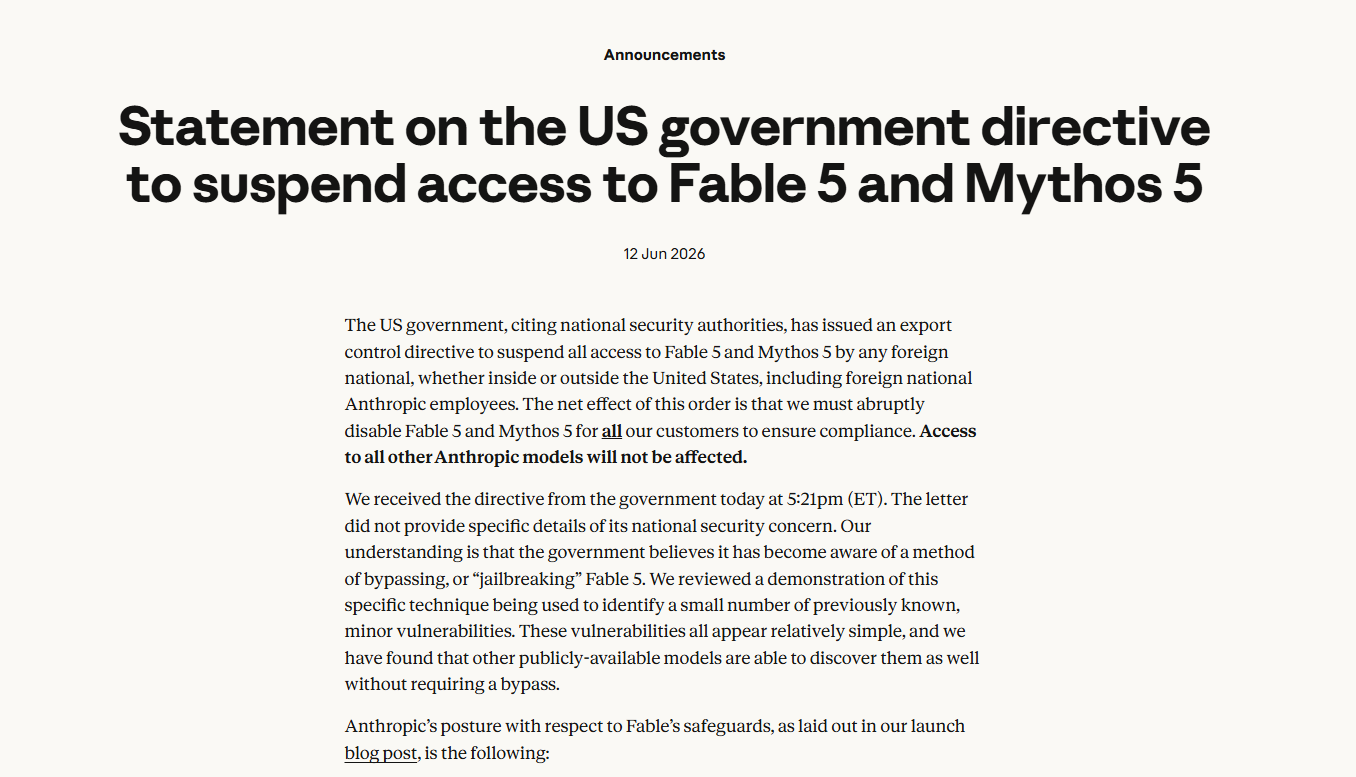
The statement shown here is Anthropic’s own official account, published the same evening the directive arrived. Key line: “The net effect of this order is that we must abruptly disable Fable 5 and Mythos 5 for all our customers to ensure compliance.”
That “for all our customers” part is the thing that turned this from a foreign-access restriction into a global shutdown. The legal target of the directive was foreign nationals specifically. But Anthropic has no way to filter users by nationality in real time across AWS Bedrock, Google Cloud, Microsoft Azure Foundry, Snowflake, Box, and every other integration point. So rather than partially comply and risk legal exposure, they took both models down for everyone everywhere, US users, foreign users, and even Anthropic’s own foreign national employees.
The government’s stated reason was a jailbreak. Someone had demonstrated a technique for bypassing Fable 5’s cybersecurity safeguards, the filters that stop the model from accessing the advanced cyber capabilities built into the underlying Mythos architecture. The concern was that a consumer-facing AI model with those guardrails defeated becomes an unrestricted cyber tool. That’s a legitimate concern.
Anthropic disputed the severity. In their statement, they said the jailbreak technique they were shown identified “a small number of previously known, minor vulnerabilities” and that “other publicly-available models are able to discover them as well without requiring a bypass.” The vulnerability is real, but Anthropic’s position was that shutting down Fable 5 specifically was disproportionate since the same results were achievable through other tools that faced no restrictions.
The government’s version came through White House AI adviser David Sacks on X the following day:
💬 Expert quote, verified: David Sacks on X, June 13, 2026: “A highly credible trusted partner of both Anthropic and the USG who was testing Fable came forward with a jailbreak of those guardrails.”
I’ve had a number of conversations with folks inside and outside government about the current situation with Anthropic, and here is what I believe to be true:
— As we know, Anthropic publicly released its Mythos class models earlier this week under the commercial name Fable.…
— David Sacks (@DavidSacks) June 13, 2026
Sacks also said Anthropic had been offered a choice, fix the jailbreak or voluntarily pull the model, and declined both. Anthropic disputed this framing and said it wasn’t given a meaningful opportunity to patch before the directive landed.
Then came the detail that made this even more complicated. That “highly credible trusted partner” was widely identified as Amazon. This matters because Amazon is Anthropic’s largest cloud partner and one of its biggest investors. Amazon CEO Andy Jassy reportedly alerted Treasury Secretary Scott Bessent to the jailbreak finding on June 11, the Commerce Department directive followed the next day.
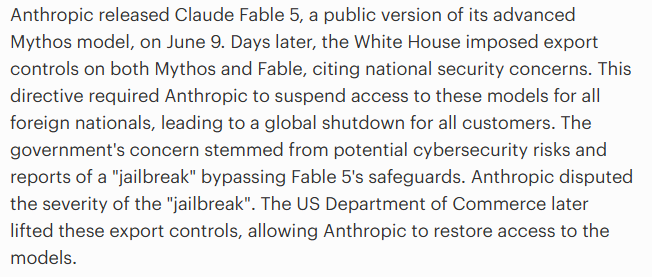
The models stayed down for 19 days. Fable 5 returned to global service on July 1, 2026, with a new cybersecurity classifier blocking the reported jailbreak in over 99% of cases. Mythos 5 remains restricted to US-approved organizations under Project Glasswing and has not returned to public access.
The Part Nobody Covered: The Dario Amodei Irony
Here’s the detail that every piece of coverage mentioned briefly and none of them properly unpacked.
Two days before the Claude Fable 5 shutdown, on June 10, Anthropic CEO Dario Amodei published an essay called “Policy on the AI Exponential.” In it, he explicitly argued that governments should have legal authority to take down frontier AI models that fail safety testing. He compared it to the FAA’s power to ground unsafe aircraft. He wrote that “the government should have the power to block or deter deployment of the model if it is determined, in light of third-party assessment, to present unacceptable risks.”
Two days later, that exact authority was used to shut down Claude Fable 5, his own flagship model.
This isn’t just ironic. It’s important context for understanding what kind of precedent this sets. Anthropic’s own CEO had publicly endorsed the legitimacy of government model shutdown powers. When the government then exercised those powers against Anthropic, the company found itself in a position where it had committed to the principle but was disputing the specific application. That’s a genuinely difficult argument to make.
The legal mechanism the government used is called the “deemed export” doctrine, under 15 CFR 734.13. Under US export control law, providing a foreign national access to a controlled technology via a hosted cloud endpoint is the legal equivalent of physically shipping it to their home country. This doctrine has existed for decades and been applied to physical goods and traditional software. The Claude Fable 5 shutdown is the first documented case of it being applied to a commercially deployed AI model served via API.
That’s the precedent that matters beyond Fable 5 specifically. Every frontier AI lab that serves foreign nationals via API is now exposed to the same risk. An immediate, government-ordered global shutdown with no advance warning and no statutory due process is a confirmed, documented possibility for any AI product with frontier-level capabilities.
What the Fable 5 Shutdown Means for Businesses Building on AI
This is where the Claude Fable 5 story stops being about one model and starts being about how any business that relies on AI should think about their stack.
The Fable 5 shutdown affected companies in finance, healthcare, SaaS, and critical infrastructure simultaneously. Enterprise clients running workflows built on Fable 5 lost them overnight, without exception, prior warning, or meaningful recourse. Platforms affected all at once included AWS Bedrock, Google Cloud, Microsoft Azure Foundry, Snowflake, Box, and the direct Claude API. If you had a Fable 5 integration anywhere in that stack, it broke at the same time.
The force majeure clauses in most enterprise AI vendor contracts don’t clearly account for this scenario. A standard force majeure clause covers natural disasters, wars, and events outside the vendor’s reasonable control. A government directive targeting a specific model is legally ambiguous in most contracts. Several legal teams reportedly discovered this gap the hard way during the 19 days Claude Fable 5 was down.
The practical lesson isn’t “don’t use Claude” or “avoid US AI platforms.” It’s that treating an AI vendor like a standard SaaS subscription tool needs updating. A SaaS subscription cancels with 30 days notice. A government export control directive targeting your AI model gives you 90 minutes. Those are different risk profiles, and your contingency planning needs to reflect that.
| Risk Layer | Old Assumption | Post-Fable 5 Reality | What To Do |
|---|---|---|---|
| Model Access | Your AI vendor controls availability. Outages are technical. | Governments can order immediate shutdowns of specific models with no advance notice or transition period. | Maintain tested fallback prompts for at least one alternative model. Claude Opus 4.8 stayed up throughout the Fable 5 shutdown. Build model-agnostic wrapper layers where practical. |
| Contract Coverage | Force majeure covers unexpected outages. | Government export control directives may not qualify as force majeure under standard contract language. | Ask your AI vendor whether government-ordered model-specific shutdowns are covered under SLA or refund terms. Get it in writing before you need it. |
| Vendor Concentration | Single-vendor AI stacks are fine if the vendor is reliable. | Single-vendor stacks on a specific model are exposed to regulatory action targeting that model regardless of vendor reliability. | Diversify across at least two providers for critical workflows. Developers who had tested GPT-5.5 or Opus 4.8 fallbacks resumed within hours of the Fable 5 shutdown. |
| Geopolitical Exposure | US AI platforms are stable for global teams. | Frontier US AI models can be restricted under export control law, affecting your entire team if you have non-US nationals. | Document which models your critical workflows depend on. If your team includes non-US nationals, know whether those models have export control exposure under the deemed export doctrine. |
For the broader question of how Claude compares to the alternatives available right now, our GPT-5.6 vs Grok 4.5 vs Claude comparison covers the current frontier model landscape for production use decisions.
Best Claude Alternatives If Fable 5 Gets Paused Again
During the 19 days Claude Fable 5 was down, developers had to make a real decision fast. Here’s what most turned to and how each one handles the tasks Fable 5 was primarily used for:
Claude Opus 4.8 was the cleanest fallback. Same vendor, same API format, stayed fully available throughout the entire Claude Fable 5 shutdown period, and handles most tasks with slightly lower performance on frontier benchmarks. If you’re already on Claude, this is your first fallback.
GPT-5.5 and GPT-5.6 are the most directly competitive on coding and reasoning. Different API format, different model behavior, requires rewritten prompts. Fable 5 scored 70% PASS@1 on Datacurve’s DeepSWE benchmark, three points above GPT-5.5 at launch. That gap is real but workable for most teams.
GLM-5.2 from Zhipu AI became a notable option during the shutdown specifically because it’s a non-US model not subject to US export control law. Developers working with international teams or building for global markets started testing it seriously during the 19-day window. If geopolitical exposure to US regulation is your primary concern, a non-US frontier model for at least part of your stack is worth evaluating.
For the product-level question of whether to stay in Anthropic’s ecosystem or diversify across platforms, our Claude Cowork vs ChatGPT Enterprise comparison covers the decision from an enterprise workflow perspective.
The Honest Verdict: Is Fable 5 Safe to Build On Now?
Here’s the real answer: Fable 5 came back, but the conditions that caused the Claude Fable 5 shutdown haven’t changed.
The deemed export doctrine still applies to every frontier AI model. The government’s ability to issue emergency export control directives with no advance warning still exists. Anthropic still can’t filter foreign nationals from US users in real time across all its integrations, meaning the next time a government directive targets a specific model, a global shutdown for everyone is still the most likely compliance path.
That’s not an argument against using Fable 5. The model is genuinely strong, and the risk of a repeat event isn’t high for most workflows. But it’s an argument for not building your core product around any single AI model without a tested fallback. The Claude Fable 5 shutdown confirmed a risk that AI vendors have never had to explicitly disclose: that your access to a specific model, even one you’re paying for, can be removed within hours by a decision you had no input into.
Teams building AI-assisted workflows that are durable rather than fragile should read our piece on how to make money with AI instead of losing your job to it, which covers the broader question of building on AI without creating risky single points of failure. And if you want the full picture of what was available during the 19 days Fable 5 was down, our Claude Sonnet 5 developer review covers the models that kept working.
FAQ
1. Why did Claude Fable 5 get shut down? The US government issued an emergency export control directive on June 12, 2026, ordering Anthropic to suspend access to Fable 5 and Mythos 5 for all foreign nationals. Anthropic had no way to filter users by nationality in real time, so it shut both models down for every customer globally. The government’s stated reason was a reported jailbreak bypassing Fable 5’s cybersecurity safeguards.
2. Did Claude Fable 5 ever come back after the shutdown? Yes. The US Department of Commerce lifted the export controls on June 30, 2026, and Fable 5 returned to global service on July 1, 19 days after the Claude Fable 5 shutdown. It came back with a new classifier blocking the reported jailbreak in over 99% of cases. Mythos 5 remains restricted to US-approved organizations under Project Glasswing.
3. Could the US government shut down my AI access again? Yes, under the same deemed export doctrine it used when Claude Fable 5 got shut down. Every frontier AI model served via API to foreign nationals is potentially subject to export control directives. The Fable 5 shutdown was the first documented case of this doctrine applied to a commercially deployed AI model, but it set a clear precedent.
4. What are the best Claude alternatives if Fable 5 gets paused again? Claude Opus 4.8 is the cleanest immediate fallback since it stayed fully available during the entire Claude Fable 5 shutdown and uses the same API format. GPT-5.5 and GPT-5.6 are the most competitive alternatives for coding and reasoning tasks. GLM-5.2 from Zhipu AI is worth considering specifically because it’s a non-US model not subject to US export control law.
5. Was the Claude Fable 5 shutdown a precedent for AI regulation? Yes, it was the first documented case of a US government export control directive forcing a frontier AI model offline after public launch. It confirmed that the deemed export doctrine under 15 CFR 734.13, previously applied to physical goods and traditional software, can be applied to AI models served via hosted API. That’s a new, confirmed regulatory risk for every frontier AI lab.
- Claude Sonnet 5 for Developers Review — covers the Claude models that stayed available during the Fable 5 shutdown.
- GPT 5.6 vs Grok 4.5 vs Claude: Which Is Better? — the current frontier model landscape for evaluating alternatives after the shutdown precedent.
- Does Claude Cowork Actually Replace ChatGPT Enterprise? — relevant if you’re deciding whether to stay in Anthropic’s ecosystem or diversify.
- How to Make Money With AI Instead of Losing Your Job — covers building durable AI-assisted workflows rather than fragile single-model dependencies.
Related Web Stories:
- Claude vs Grok 4.5 vs GPT-5.6: Who Wins?
- Why Claude Now Wants Your Government ID
- Meta Just Put AI Image Gen in Your Instagram